


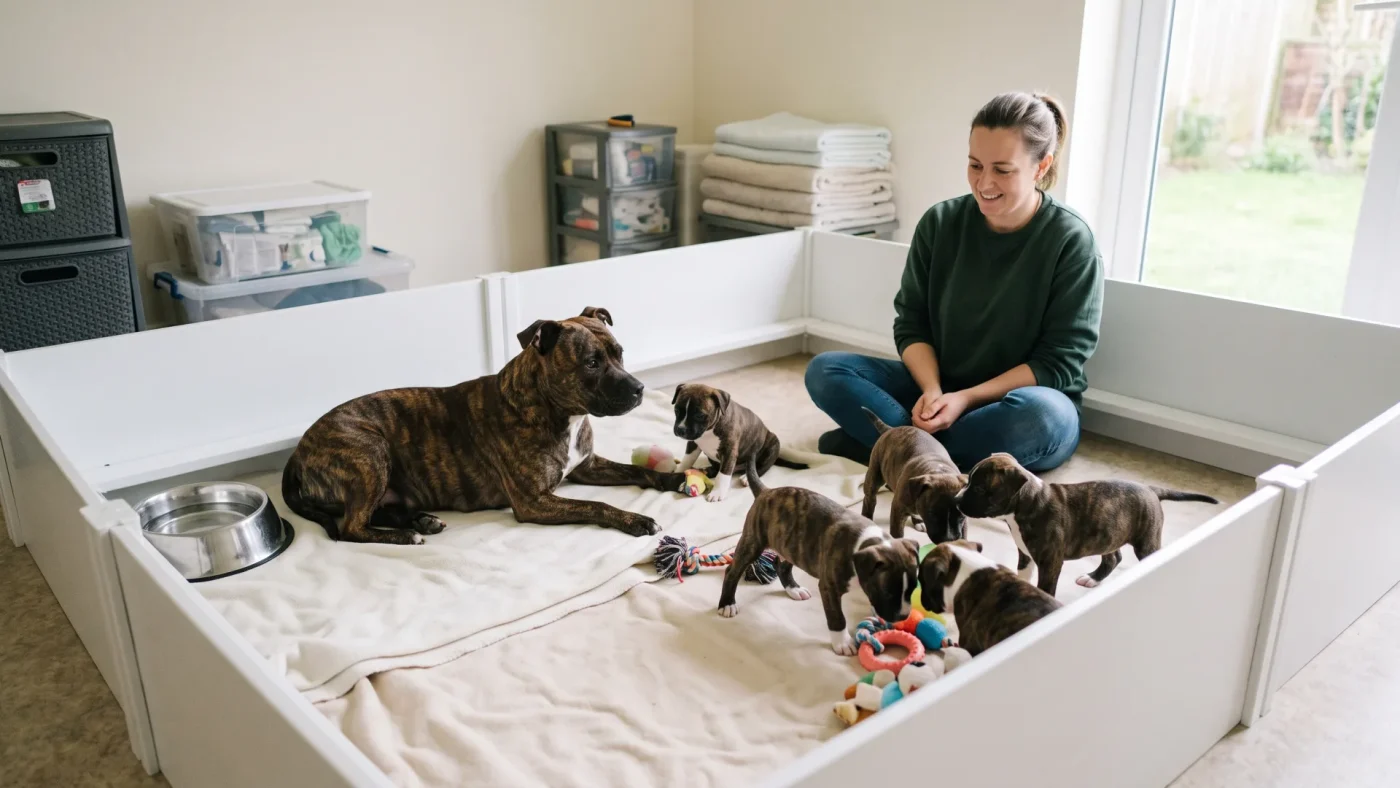
When you are buying an English Staffordshire Bull Terrier (Staffordshire Bull Terrier), the breed known in Turkey simply as the “English Staff”, choosing the breeder is an even more important decision than choosing the puppy itself. The health and temperament of the dog you bring home, and the documents it arrives with, depend largely on which English Staffy breeder produced it and under what conditions. With a puppy from the wrong source, problems sometimes surface not in the first few weeks but months later.
We have gathered the breed’s general characteristics, its health risks and a short puppy checklist in our English Staffordshire Bull Terrier guide. This article goes one step before that checklist: how to tell a reliable dog breeder apart from a mere puppy producer or a puppy farm, which documents to ask for, and which behaviours should make you walk away.
The Difference Between a Breeder, a Producer and a Puppy Farm
Not everyone who sells puppies is a breeder. A responsible breeder breeds to protect the breed and to raise healthy dogs. They plan a small number of litters, choose every pairing on the basis of test results and stand behind the dogs they sell for their whole lives.
A puppy farm (also called a dog farm or puppy mill), on the other hand, treats the puppy as a product. Many females are bred one litter after another, the puppies grow up in cages or in pens kept apart from the house, and sales are mostly made through social media and classified ad sites. In these places genetic tests may be skipped, veterinary checks may be a mere formality and the puppies may grow up without enough contact with people.
The result can be skin and digestive problems, a risk of inherited disease and behavioural problems caused by a lack of socialisation. The way to assess the small-scale producers who sit between these two extremes is to go through the signs below one by one. A polished video or a large following is no substitute for these signs.
What Does a Responsible English Staffy Breeder Do?
Tests the Parents Before Mating Them
In this breed, carrier status for two inherited diseases can be identified with a DNA test: L-2-HGA and hereditary cataracts (HC-HSF4). In addition to these two tests, the Kennel Club in the UK recommends eye examinations and elbow screening for breeding dogs, and litter eye screening for puppies. You can check the current list on the Kennel Club’s breed page.
Both diseases are inherited recessively. That is why a “carrier” result is not bad news on its own; what really matters is that two carriers are never mated with each other. A good breeder shows you the results, explains this distinction and can tell you which risk the puppy is clear of, and why.
The test certificate should show the name of the laboratory and the dog’s microchip number. A screenshot that cannot be linked to a particular dog does not count as a test result. For the breed’s other health risks, see our article on Staffordshire Bull Terrier health issues.
Raises the Puppies Indoors and with Their Mother
A puppy’s first weeks largely shape the kind of dog it will become. A puppy that stays with its mother and littermates learns from them how to control the strength of its bite and how to read other dogs’ signals. A puppy raised inside the house arrives already used to everyday stimuli such as the vacuum cleaner, the doorbell and kitchen noises.
A responsible breeder does not take a puppy away from its mother too early. The common recommendation of veterinary organisations is at least 8 weeks. In Turkey, the regulation on pet production and sales premises also prohibits keeping kittens and puppies younger than two months at sales premises. Someone who offers you a six-week-old puppy as “ready to go” is following their own schedule, not the puppy’s.
Does Not Leave Socialisation to Chance
Before handover, a good breeder starts getting the puppies used to meeting different people, being picked up, having their paws and ears checked and walking on different surfaces. They should be able to explain how they do this with concrete examples. These first steps matter even more in the English Staff, which can be selective with other dogs. We cover what you need to do after handover in our article on socialising an English Staff puppy.
Provides a Written Contract and Complete Paperwork
The sale should be made with a contract that sets out the rights and obligations of both parties. The contract should include the puppy’s microchip number, date of birth, dam and sire, handover date, the scope and duration of the health guarantee, the return conditions and the payment details. The name and stamp of the veterinarian who carried out the vaccinations and parasite treatments should appear in the records.
Verbal promises count for nothing once a problem arises. If you run into an illness after handover, the documents in your hands become the basis for every step you take. We explain what you can do in that situation, step by step, in our article on what to do if you bought a sick puppy.
Stays Reachable After the Sale
Your relationship with a responsible breeder does not end when you pay. They answer when you ask about feeding, house training or skin problems. Good breeders write into the contract that, if the owner can no longer look after the dog, they will take it back at any age or help find it a new home.
Asks You Questions Too
A reliable dog breeder does not hand a puppy to the first buyer who comes along. They ask how many hours a day nobody is at home, whether you have another dog, whether you have looked after a dog before and what kind of home you live in. These questions are not meant to test you; they are there so that the puppy goes to the right home. Be wary of a seller who asks nothing and only wants to know “when are you collecting?”.
Which Documents Should You See?
Documents show both the puppy’s history and how far the seller operates on the record. Here is how to check each one.
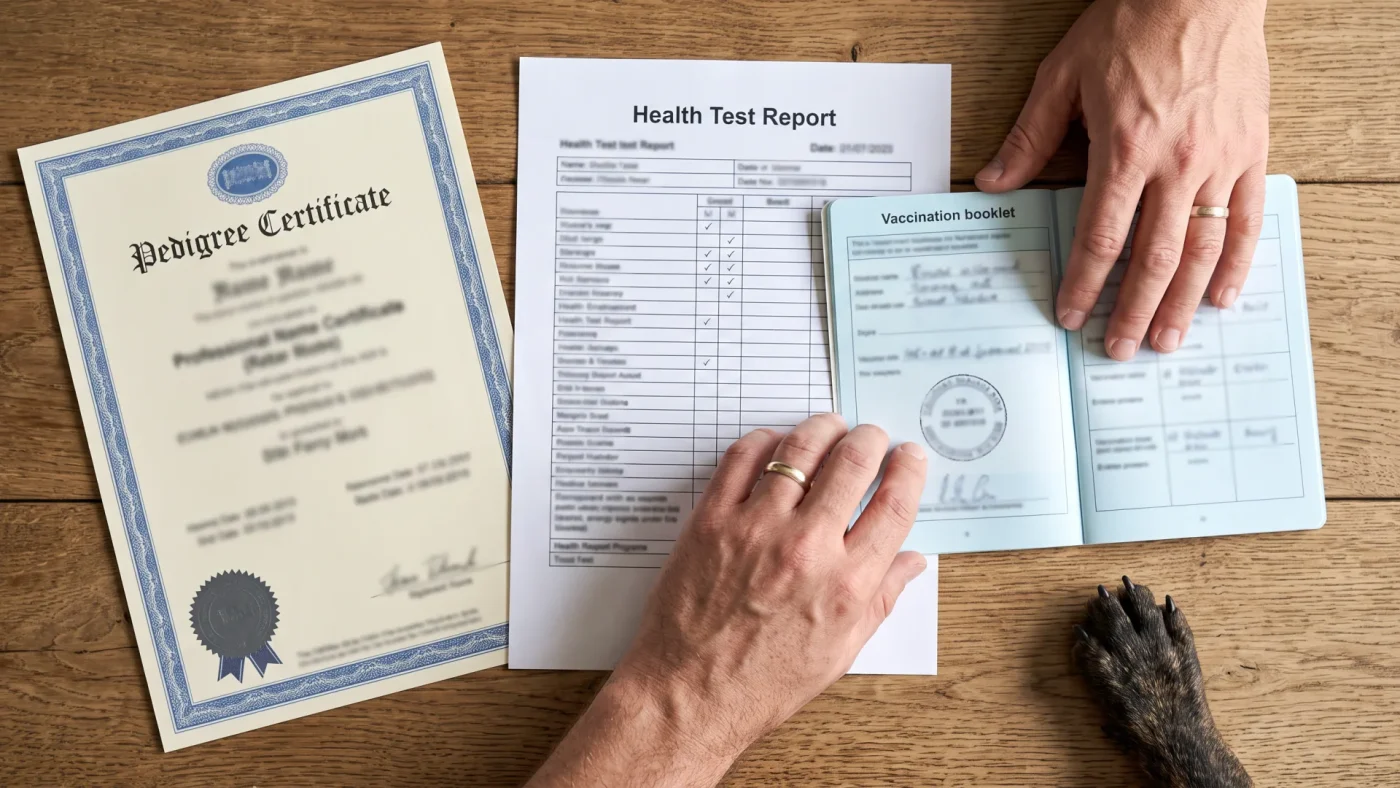
| Document | What does it show? | How do you check it? |
|---|---|---|
| Pedigree | The puppy’s breed and lineage. It is not a health guarantee. | Compare the registration numbers of the dam and sire with the documents of the dogs you have seen. |
| DNA test results | The L-2-HGA and HC-HSF4 status of the dam and sire. | The laboratory name and the dog’s microchip number should be on the certificate. |
| Eye and elbow reports | The parents’ examination results. | The name of the examining veterinarian and the date should be included. |
| Vaccination and parasite records | The treatments given to the puppy. | Every entry should have the date, the vaccine label, and the veterinarian’s name and stamp. |
| Microchip, passport and PETVET registration | The puppy’s official identity. | Have your own vet scan the chip and check that the number matches the documents. |
| Contract and sales document | What you are buying and the seller’s obligations. | The seller’s identity, address, payment and return terms should be clearly stated. |
| Breeding premises operating permit | That commercial breeding is carried out under an official permit. | Check that the address on the permit is the place you visited. |
What a Pedigree Does and Does Not Show
A pedigree documents that the puppy is an English Staff and that its lineage is registered. In Turkey this record is kept by the Federation of Dog Breeds and Cynology (Köpek Irkları ve Kinoloji Federasyonu, KIF), a full member of the Fédération Cynologique Internationale (FCI). The American Staffordshire Terrier, a breed the English Staff is often confused with, was added to the banned list by a Ministry circular in 2021, so if your dog’s breed is ever questioned, the pedigree is the strongest document you have.
A pedigree is not a health certificate, however. A puppy from two pedigree dogs mated without testing is no safer from inherited disease than a puppy without a pedigree. If you are told the pedigree “will be issued later”, ask whether the dam and sire are registered and how the litter will be recorded.
Microchip, PETVET and Change of Ownership
Law No. 5199 on Animal Protection requires cat and dog owners to have their animals registered using digital identification methods. The microchip is implanted by a veterinarian or under a veterinarian’s supervision, the record is entered into the Pet Registration System (PETVET) of the Ministry of Agriculture and Forestry, and a passport is issued for the dog.
When a dog changes hands, the new owner must apply to the provincial or district directorate of agriculture and forestry within 60 days with a Pet Ownership Change Certificate (Ev Hayvanı Sahip Değişikliği Belgesi). So at handover, ask whose name the chip is registered in and ask the seller for the transfer document. A puppy whose chip number does not match its documents, or whose registration is “in a friend’s name”, can leave you in a difficult position later on.
Sales Premises and the Legal Framework in Turkey
A provision added to the Animal Protection Law in 2021 banned keeping cats and dogs at pet sales premises (pet shops); the transition period ended in July 2022. Under the law, these premises may now only sell cats and dogs kept at production premises authorised by the Ministry. A shop displaying puppies is therefore operating in breach of this rule.
Pet production, sales, boarding and training premises are subject to the relevant regulation of the Ministry of Agriculture and Forestry. Under this regulation, these businesses must obtain an establishment and operating permit from the provincial directorate of agriculture and forestry. At these premises, puppies are identified under veterinary supervision when they reach two months of age, a sales document is completed for every animal sold, and puppies may only be sold once fifteen days have passed since their last vaccination.
You are entitled to ask anyone who regularly sells puppies for their operating permit. Someone who advertises a new litter every month and cannot show a permit is working outside the supervision the legislation provides for. Because the legislation changes from time to time, you can ask the directorate of agriculture and forestry in your province for the current rules.
Red Flags: Signs That Should Make You Walk Away
None of the signs below always means a scam or a puppy farm on its own. But if two or three of them appear together, seriously consider walking away, however cute the puppy may be.
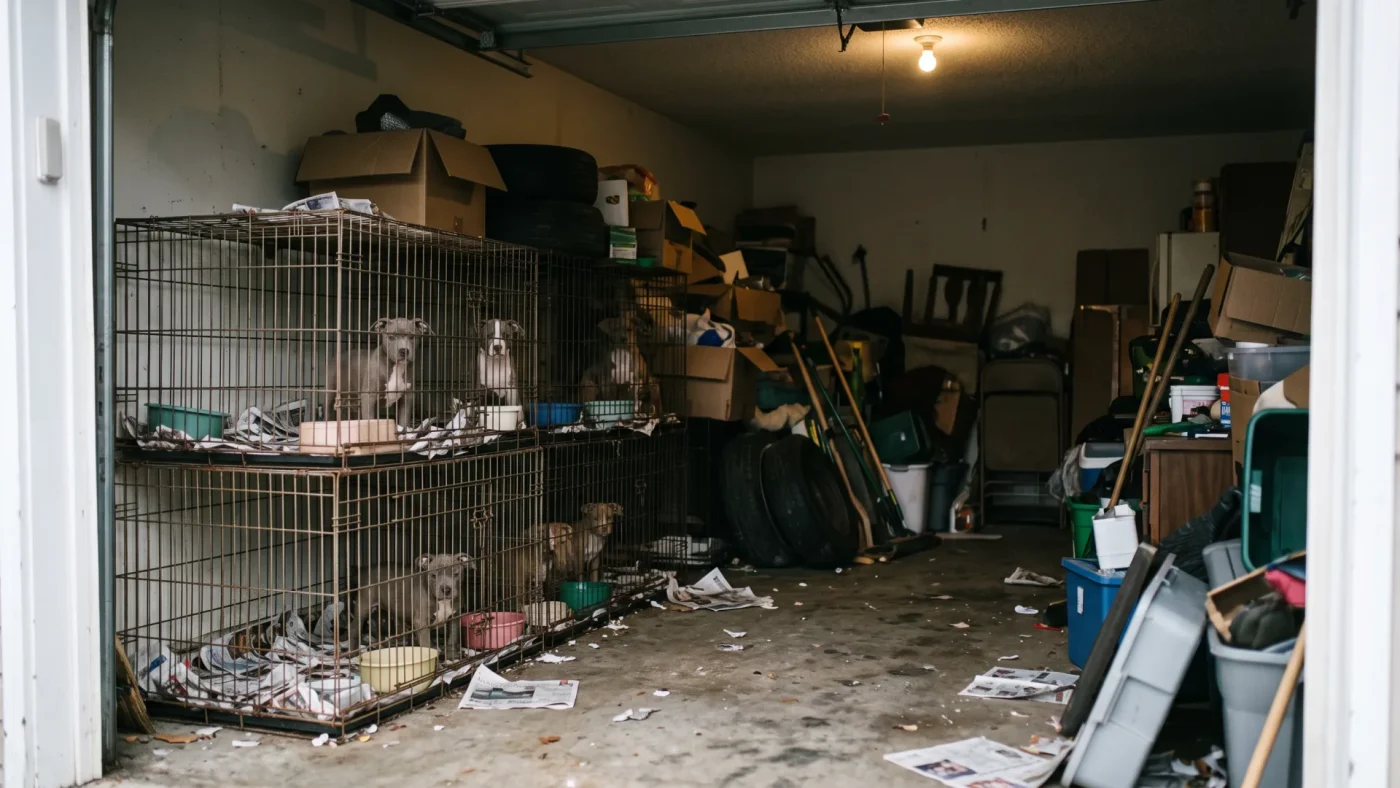
- Always has puppies: If you get the reply “we have puppies available” whichever month you write, either a large number of females are giving birth non-stop or the puppies are being collected from elsewhere.
- Many breeds at once: Someone who sells five other breeds alongside the English Staff is most likely a dealer trading in puppies, not a breeder devoted to one breed.
- Handover in a car park or on the street: The suggestion “don’t come to the house, let’s meet over there” stops you from seeing where the puppy was raised and who its mother is.
- A deposit before you have seen anything: Being asked for a deposit before you have seen the puppy and its mother, or even spoken on a video call. Online puppy scams often begin with this step.
- Sending by courier: The offer to “send the puppy to you by courier” means you buy without visiting. The journey is also a serious source of stress for a young puppy.
- A “rare colour” premium: Blue is one of the standard colours, not a rare variety. “Exotic” colours that are not in the standard, meanwhile, may be a sign not of quality but of a pairing outside the standard. The details are in our article on English Staffy colours.
- No test certificates: Answers such as “our dogs never get ill” or “our vet has checked them” are not documents.
- Pressure to hurry: “There’s another buyer; if you don’t send a deposit today, the puppy will be gone” is pressure designed to stop you from thinking.
- An unexplained price: A very low price usually points to skipped testing, vaccination and care costs, while a very high price with no justification points to marketing. Ask what the price covers.
- An uninterested “mother”: If the dog presented as the mother shows no interest in the puppies at all, she may not be the real mother.
Sales on Classified Ad Sites and Social Media
After the sale of cats and dogs in pet shops was banned, the press also reported that a significant share of sales had moved to social media and classified ad sites. On these channels the seller is behind a screen; everything you see is what the seller has chosen to show you. So check the following:
- Where the photos come from: Check the images with a reverse image search. If the same photo has been advertised in other cities under other names, stay away.
- Live video: Ask for a video call that shows the puppy together with its mother, in real time and from the angles you ask for.
- Payment details: The account holder’s name should match the person you are talking to and the seller named in the contract.
- Independent experiences: Rather than relying on the reviews the seller shares, try to reach people who have bought a dog from that seller yourself. The owner experiences on our site also show what can go wrong.
What to Look for When You Visit
Visiting the breeder is the step that gives you the most information in the shortest time. Decide which questions you will ask before you go; you can take our list of 15 questions to ask the seller when buying a puppy with you. Once there, pay attention to the following:
- Environment: The smell, the cleanliness, where the puppies sleep, the water and food bowls. Are the puppies inside the house or in a separate pen?
- Number of dogs: How many adult females are there, and how many of them are pregnant or nursing at the same time?
- The mother’s condition: Her weight, skin, coat and the way she approaches you. A mother who is extremely thin or has bald patches also tells you something about the puppies.
- How the puppies look: Is there discharge from the eyes, crusting on the nose, bald patches, a swollen belly or any sign of diarrhoea? When they are awake, are they curious and lively?
- Documents: Have they been prepared before you ask, or is there a different excuse for each one?
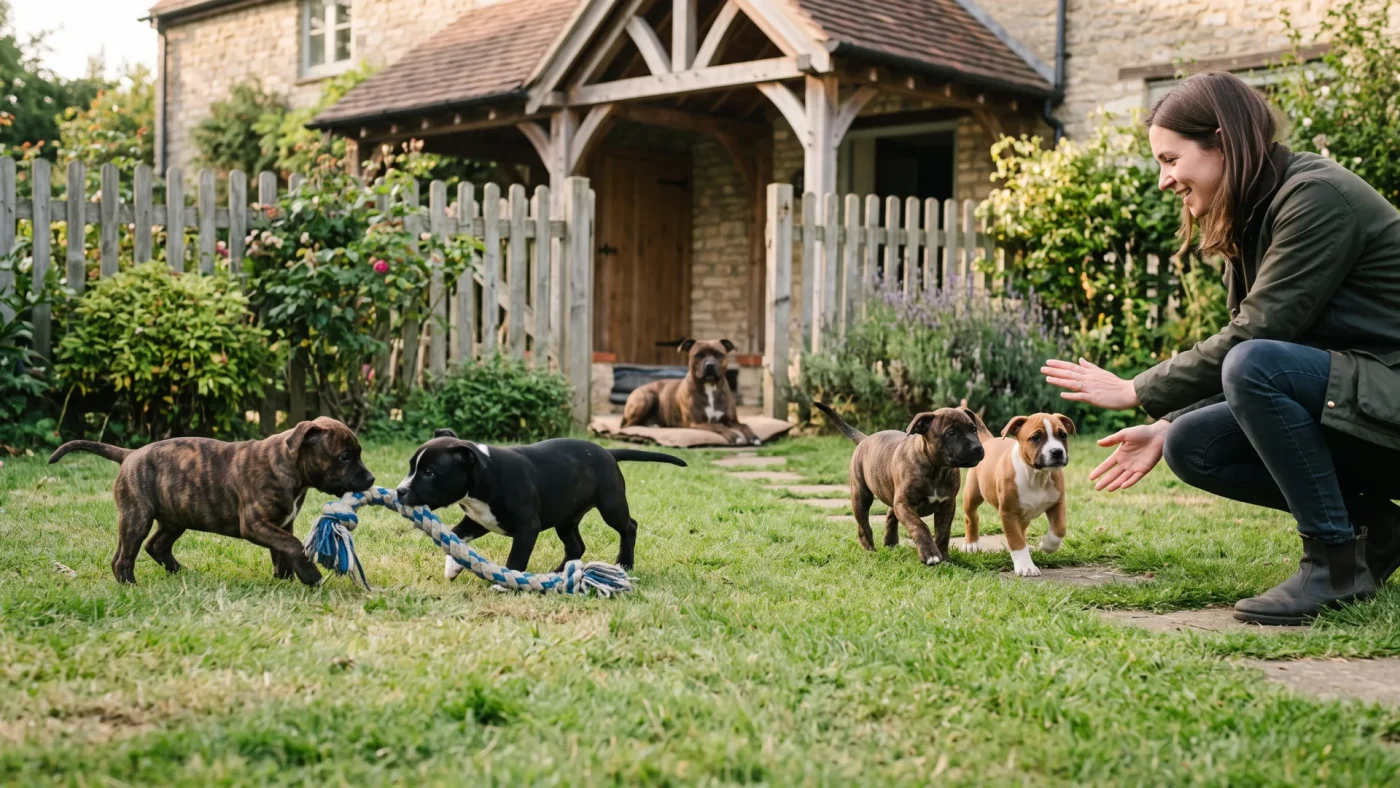
You do not have to make a decision straight after the visit. Write down what you saw and wait a day. In the first days after you collect the puppy, have it examined by a veterinarian you have chosen yourself, not one recommended by the seller.
Frequently Asked Questions
Where Should You Buy an English Staffy Puppy?
From a breeder who can show you the parents’ test results, raises the puppies at home with their mother, gives you a written contract and invites you to visit. Keeping cats and dogs in pet shops is banned in Turkey. If you find a seller through a classified ad site or social media, always see the premises in person.
Is a Pedigree Puppy a Healthy Puppy?
A pedigree documents lineage and breed, not health. For health, look at the parents’ DNA test results, their eye and elbow examinations and the puppy’s veterinary records.
What Is the Earliest Age at Which a Puppy Can Go Home?
It should be at least 8 weeks old. The regulation in Turkey also does not allow puppies younger than two months to be kept at sales premises.
Does a Reliable Dog Breeder Ask for a Deposit?
They may; breeders who keep a waiting list can take a deposit. What matters is that the deposit is paid after you have seen the breeder and the mother, against a written document that states when it will be refunded.
Is It a Problem If I Cannot See the Father?
The sire may belong to another breeder; this is quite normal. In that case, ask for the sire’s pedigree, his test certificates and, if possible, video footage of him. Not being able to see the mother, however, is something you should not accept.
Finding the right breeder takes time and often means waiting. That wait is short compared with the time you might spend in veterinary clinics after buying the wrong puppy. See the documents, visit the premises, put your questions in writing and do not hesitate to walk away from a sale you do not feel right about.

Most Read Articles
How to Stop Your English Staff Puppy Chewing Things
English Staffies can be wonderful family companions due to their loving and loyal nature. This...
Nov
Fungal Infections in Dogs (Dermatomycosis): Symptoms, Diagnosis and Treatment
Fungal infections in dogs, known in veterinary terms as dermatomycosis, are infections of the skin,...
Sep
Staffordshire Bull Terrier Health Issues: What Conditions Are They Prone To?
Staffordshire Bull Terriers, known for their loyal and energetic nature, are wonderful companions but may...
Oct