


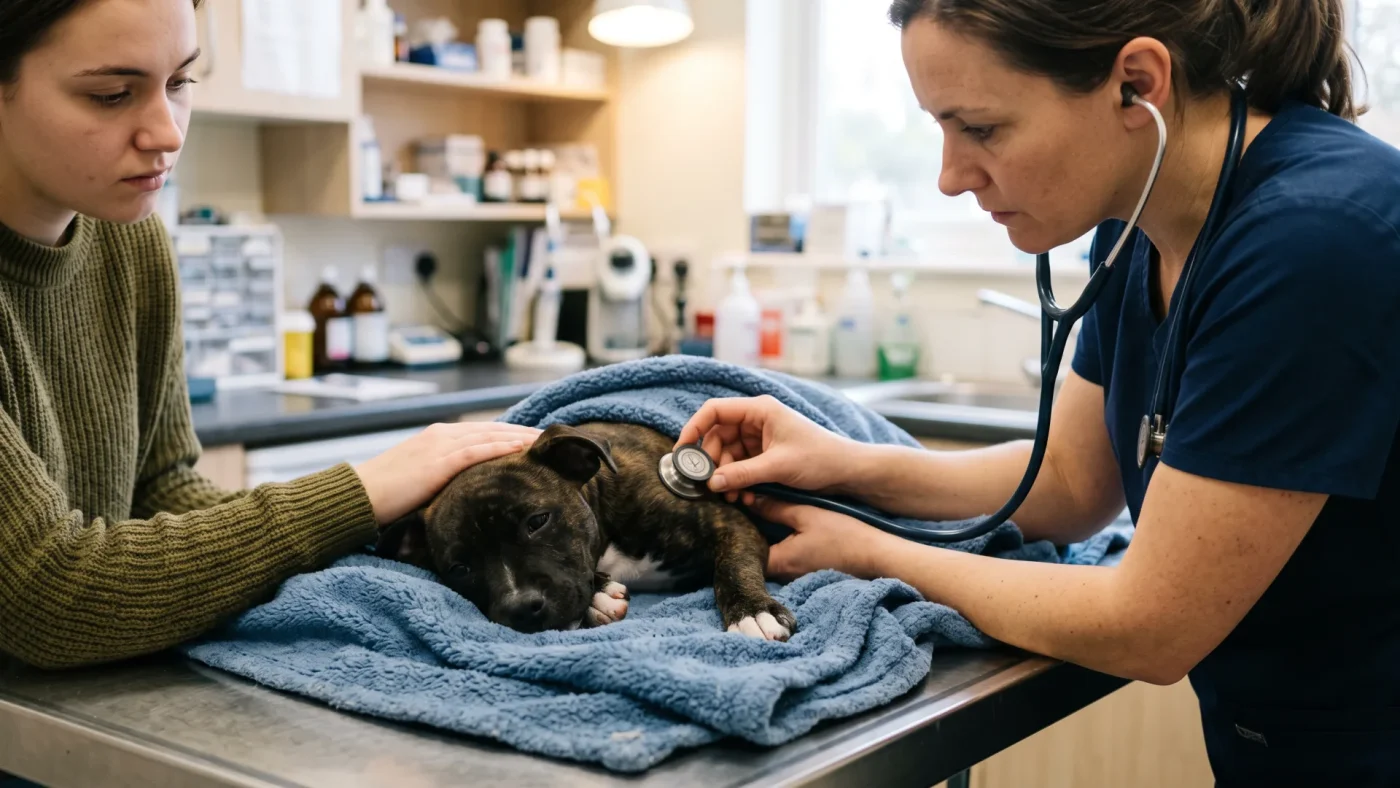
If the puppy you have just bought fell ill shortly after coming home, your first question is probably this: “I was sold a sick dog, what should I do?” In this article we set out, in order, the steps to follow so that you protect your dog’s health without losing your rights: the vet report, gathering evidence, written notice to the seller, your legal rights and where to apply.
These steps apply to every breed; on our site, we mainly collect the experiences of owners of the English Staffordshire Bull Terrier (Staffordshire Bull Terrier), known in Turkey as the English Staff. For the breed’s health risks and choosing a puppy, see our English Staffy guide. Some legal deadlines are very short, so do not put off reading this.
Summary: What to Do in the First Days
- Have the puppy examined by an independent vet and ask for a written report.
- Gather the advert, your messages, and the payment and handover documents.
- Notify the seller of the problem in writing.
- Work out which law applies, depending on whether the seller is a business or a private individual.
- Choose between the arbitration committee, mediation or the courts; report any suspicion of unlicensed breeding.
- Share your experience using only facts you can document.
Step 1: Your Dog’s Health Comes First
Your rights can wait; a sick puppy cannot. Take the puppy without delay to a vet who has no connection with the seller. If an infectious disease is suspected, keep the puppy apart from the other animals at home.
After the examination, do not settle for a verbal assessment; ask for a written report that is stamped and signed. Before an arbitration committee or a court, this report will be your strongest piece of evidence.
What Should the Vet Report Include?
- The dog’s identity: microchip number, breed, age, sex and colour.
- The date of the examination, the findings, the tests carried out and the diagnosis.
- The likely onset of the illness: the vet’s opinion on whether it may have started before the handover date.
- An opinion on whether the illness is hereditary or congenital.
- The recommended treatment, its estimated duration and its cost.
Keep all vet invoices, test results and medicine boxes; do not throw away any medicines or sprays the seller gave you at handover either. If, sadly, the puppy dies, ask for a report establishing the cause of death (a necropsy if necessary). For problems common in the breed, see our article on Staffordshire Bull Terrier health issues.
Step 2: Gather the Evidence
Disputes often come down to “who said what, and when”; keep everything you have, unaltered and with its dates:
- Screenshots of the advert: the text, the photos, phrases such as “healthy” or “fully vaccinated”, and the advert’s web address and date.
- All messages with the seller (export the chat from the app), emails and voice messages.
- The payment receipt, and an invoice or sales document if there is one.
- The contract, and any document stating a health guarantee or return terms.
- The vaccination card or pet passport, the microchip number and whose name it is registered in.
- Photos and videos you took on handover day and afterwards, and the names of the people who were with you at handover.
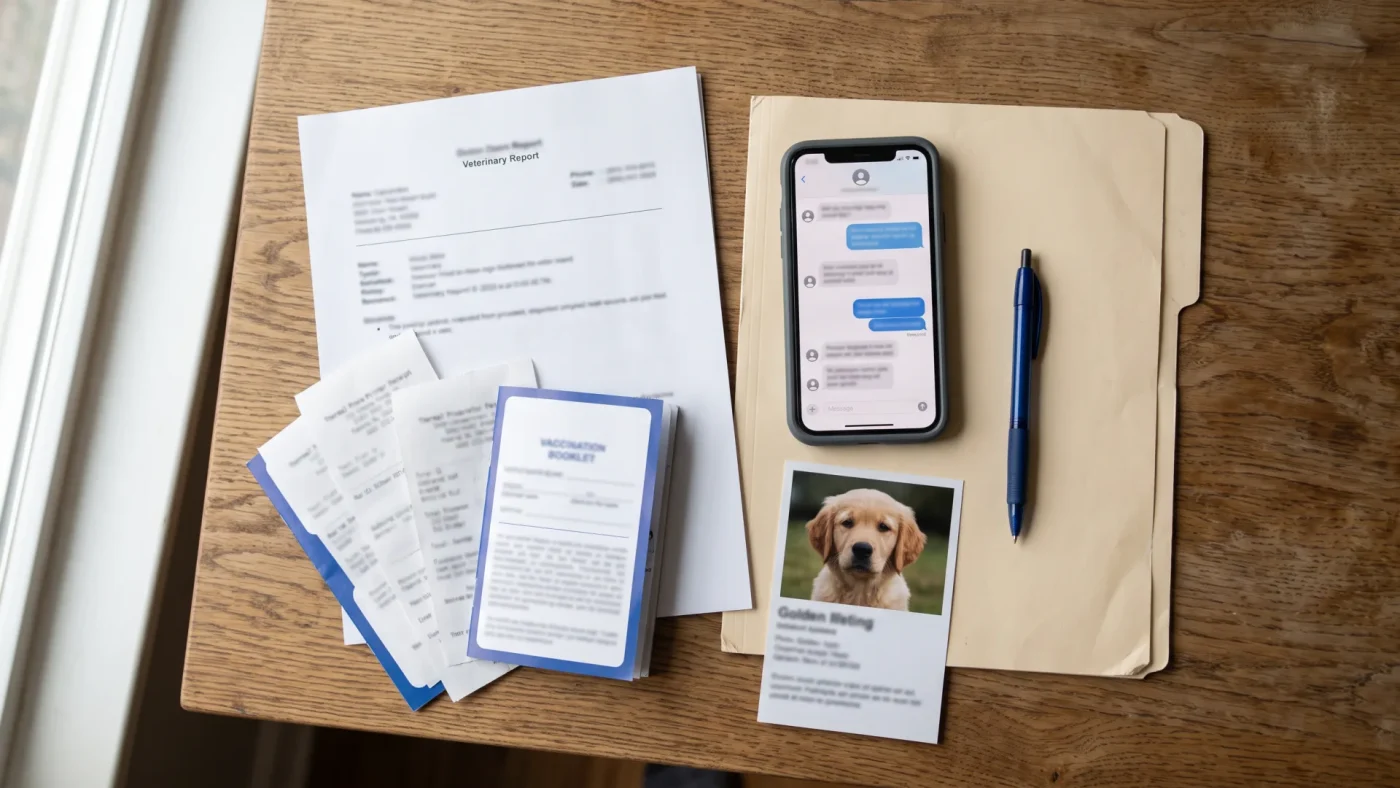
Do not crop or edit screenshots; back up the original files somewhere separate. Then put the events in date order. A simple table makes the job easier for whoever reviews your file:
| Date (example) | Event | Evidence |
|---|---|---|
| Payment day | Deposit sent | Bank receipt |
| Handover day | Puppy collected, discharge from the ear noticed | Handover video, message |
| 3 days after handover | Vet examination, diagnosis | Vet report, invoice |
| Same day | Written notice to the seller | Printout of the email |
Step 3: Notify the Seller in Writing
Phone calls cannot be proven. Notify the seller of the problem in writing, and as early as possible. The Consumer Protection Law (Tüketicinin Korunması Hakkında Kanun) lists email and text messages among the examples of a “durable medium” (kalıcı veri saklayıcısı), that is, a medium that allows information to be stored without alteration (Art. 3).

- State the purchase date, the price paid and the puppy’s identification details.
- Describe the problem the vet found and attach the report.
- State your demand clearly: for example, withdrawing from the contract, a price reduction or payment of the treatment costs.
- Use calm, factual language; accusations and insults make the process harder and expose you to legal risk.
Notarial Warning Letter (Noter İhtarnamesi)
If the seller does not respond, or if you want conclusive proof that your notice arrived, you can send a formal warning letter through a notary. The Notaries Law (Noterlik Kanunu) lists sending warning letters among the duties of notaries (Art. 60); you can write the text yourself and take it in, or have the notary draft it (Art. 106). There is a fee, and it is a good idea to have a lawyer check the text.
Step 4: Know Your Rights
Which rules apply depends largely on who the seller is: did you buy the dog from a business or breeder selling commercially, or from an individual making a one-off sale?
Does the Law Treat a Live Animal as “Goods”?
The Turkish Civil Code (Türk Medeni Kanunu) deals with animals within the provisions on ownership of movable property; for example, it states that a retention of title agreement (mülkiyeti saklı tutma sözleşmesi) cannot be made in animal sales (Art. 764). The Turkish Code of Obligations (Türk Borçlar Kanunu) also regulates the sale of animals as a type of sales contract. The definition of “goods” in the consumer law, however, refers to “movable items” and does not mention animals separately (Art. 3).
For this reason, whether an animal counts as goods under consumer law has been debated in legal scholarship. The prevailing view is that, where there is no specific rule for animals, the provisions on things also apply to animals. On this basis, a dog bought from someone selling commercially may be treated as a consumer transaction.
If the Seller Is a Business or Professional Breeder: The Consumer Protection Law
Under Law No. 6502 on Consumer Protection, a seller is a person who offers goods to consumers for commercial or professional purposes (Art. 3). Pet shops and breeders who regularly breed and sell puppies may fall within this definition. The key rules are:
- Defective goods (ayıplı mal) (Art. 8): Goods are defective if they lack the characteristics stated in the advert or by the seller, or if they reduce the benefit the consumer could reasonably expect. A sick puppy sold as “healthy” may be considered to fall within this scope.
- Easier burden of proof (Art. 10): Defects that appear within six months of delivery are presumed to have existed at the time of delivery; it is up to the seller to prove otherwise. The presumption does not apply if it is incompatible with the nature of the defect; an infection clearly caught after delivery could be an example.
- Elective rights (seçimlik haklar) (Art. 11): Withdrawing from the contract by stating that you are ready to return the dog; keeping the dog and asking for a price reduction; free repair at the seller’s expense (which, for a live animal, legal scholarship interprets as free treatment); or, where possible, replacement with an equivalent that is free of defects. Together with any of these, you can also claim compensation under the Turkish Code of Obligations.
- Time limit (Art. 12): The seller’s liability is subject to a two-year limitation period (zamanaşımı) from delivery. If the defect was concealed through gross fault or fraud, the limitation provisions do not apply.
You cannot use an elective right for a defect that you knew about, or could be expected to have known about, when the contract was made (Art. 10).
If the Seller Is a Private Individual: The Turkish Code of Obligations
If you bought the dog from a person who was not acting for commercial purposes, the Turkish Code of Obligations applies. The Code contains two provisions specific to animal sales that are stricter for the buyer:
- Written undertaking (Art. 220): “In the sale of animals, the seller is not liable for defects unless they have undertaken such liability in writing or are guilty of gross fault.” If the seller made no written commitment about the dog’s health, you need to prove gross fault, for example that they knowingly concealed the illness.
- Nine-day period (Art. 224): If the period of the seller’s liability has not been set in writing and the defect does not relate to pregnancy, the defect must be notified to the seller within nine days of delivery, and within the same period an examination of the animal by experts must be requested from the competent authority.
The obvious route for an expert examination is to ask the civil court of peace (sulh hukuk mahkemesi) where the animal is located for a determination of evidence (delil tespiti) before filing a lawsuit (Code of Civil Procedure (Hukuk Muhakemeleri Kanunu), Art. 400-401). Work out the right route for you quickly with a lawyer.
This deadline is not an absolute bar in every case: a seller at gross fault cannot escape liability by arguing that notice was given late, and the same rule applies to defects that people who sell as a profession ought to know about (Art. 225). The elective rights are similar to those in the consumer law (Art. 227). The limitation period for a lawsuit is two years from delivery; a seller at gross fault cannot rely on this period (Art. 231).
| Issue | Seller is a business or professional | Seller is a private individual |
|---|---|---|
| Law | Law No. 6502 on Consumer Protection | Law No. 6098, Turkish Code of Obligations |
| Seller’s liability | Liable for defective goods (Art. 8-11) | Requires a written undertaking or gross fault (Art. 220) |
| Notice | No separate notice period set for the consumer | If no period was set in writing: 9 days, plus a request for expert examination (Art. 224) |
| Proof | For the first 6 months, the defect is presumed to have existed at delivery (Art. 10) | General rules |
| Limitation period | 2 years (Art. 12) | 2 years (Art. 231) |
| Where to apply | Arbitration committee or consumer court | Civil court of first instance |
Step 5: Where to Apply
Consumer Arbitration Committee
If the seller is a business and the value of the dispute is below a certain threshold, you must apply to the Consumer Arbitration Committee (Tüketici Hakem Heyeti) (6502, Art. 68). The threshold is raised every year by the revaluation rate (yeniden değerleme oranı). According to the Ministry of Trade (Ticaret Bakanlığı) communiqué published in Official Gazette (Resmî Gazete) No. 33116 of 23 December 2025, the threshold for applications made in 2026 is TRY 186,000; disputes below it are handled by provincial or district arbitration committees.
You can apply to the committee where you live or where the sale took place. Its decisions are binding on the parties; they can be challenged before the consumer court (tüketici mahkemesi) within two weeks of notification (Art. 70). According to the Ministry of Trade’s information notice, applications are decided within six months at the latest, and this period can be extended by up to three months.
Applying Online Through e-Devlet (TÜBİS)
Online applications are made through the Ministry of Trade’s Consumer Information System (Tüketici Bilgi Sistemi, TÜBİS), which you log in to through e-Devlet, Turkey’s e-Government portal. The form asks for your identity and contact details, the seller’s details, the subject of the dispute, your demand and the value of the dispute in Turkish lira. Attach the vet report, the payment receipt, your messages and the contract. You can also apply in person, by post or through a lawyer; oral applications are not accepted.
Above the Threshold: Mediation and the Consumer Court
If the value is TRY 186,000 or more, you cannot apply to the arbitration committee. In that case, applying to a mediator is a precondition for filing a lawsuit in the consumer court (6502, Art. 73/A). Whether the process ends in agreement or not, the mediation fee the consumer would otherwise have to pay is covered from the Ministry of Justice (Adalet Bakanlığı) budget, within the limit set by the law. Lawsuits filed by consumers in the consumer court are exempt from court fees (harç) (Art. 73).
When the Seller Is a Private Individual
In a sale that is not a consumer transaction, the arbitration committee and consumer court route cannot be used; the case is heard by the civil court of first instance (asliye hukuk mahkemesi), which has general jurisdiction (Code of Civil Procedure, Art. 2). Sales contracts are not among the areas of mandatory mediation listed in Article 18/B of the Law on Mediation in Civil Disputes (Hukuk Uyuşmazlıklarında Arabuluculuk Kanunu); if you wish, you can opt for voluntary mediation.
Suspected Unlicensed Breeding or Sales: The Provincial Directorate of Agriculture and Forestry
The authority to supervise the enforcement of Law No. 5199 on Animal Protection (Hayvanları Koruma Kanunu) lies with the Ministry of Agriculture and Forestry (Tarım ve Orman Bakanlığı) (Art. 17). Under this law, animals must be in good health when they are sold; cats and dogs may not be kept at pet shops, and only cats and dogs from breeding premises licensed by the Ministry may be sold there (Art. 10).
If you suspect unlicensed breeding, dogs being kept in a shop or sick animals being sold knowingly, you can submit a written application with your documents to the provincial or district directorate of agriculture and forestry (il veya ilçe tarım ve orman müdürlüğü). This is a request for an administrative inspection; to get your money back, you need to use one of the routes above separately.
Sharing what happened to you is one of the most effective ways to warn people who will come across the same adverts. You can submit your documented experience through our add a complaint page and read what other owners have been through in our complaints section.
Important: Write only about facts you can document. Insults, statements that violate personality rights (kişilik hakları) or accusations you cannot prove expose you to legal risk. A measured account based on facts is more convincing for readers and also protects you legally.
- Make sure the dates and events you describe match your documents.
- Describe what happened instead of labelling it: for example, “Three days after handover, the vet made this diagnosis”.
- Do not share third parties’ phone numbers, addresses or identity details.
- If you have an application in progress, talk to your lawyer before posting.
Frequently Asked Questions
Do I Have to Give the Dog Back?
No. If you choose to withdraw from the contract, you state that you are ready to return the dog and ask for the price to be refunded. If you want to keep the dog, you can use the other rights, such as a price reduction or free treatment. In sales governed by the Turkish Code of Obligations, the judge may order repair or a price reduction instead of withdrawal if the circumstances do not justify withdrawal (Art. 227).
Can I Claim the Treatment Costs?
You can, but the outcome depends on the specific case. The consumer law expressly states that compensation can be claimed together with one of the elective rights (Art. 11). The vet report and invoices are decisive in showing that the costs arose from the defect present at the time of sale.
How Long Do I Have?
If the seller is a business, liability is subject to a two-year limitation period from delivery, and the burden of proof is easier for defects that appear within the first six months. If the seller is an individual and no period was set in writing, you may need to notify the defect and request an expert examination within nine days. In either case, do not wait.
Can a Dog Bought From a Pet Shop Be Returned?
If the dog had an illness at the time of delivery, you can withdraw from the contract, return the dog and ask for the price to be refunded. The rights in this article concern a defective animal, that is, one sold while sick. It is also worth remembering that, under the law, dogs may not be kept at pet shops.
If the Puppy Has Died, Do I Lose My Rights?
Not automatically. Under the Turkish Code of Obligations, if an item delivered with a defect is lost because of that defect, this does not prevent the buyer from withdrawing from the contract (Art. 228). In this situation, documenting the cause of death with a vet report is especially important.
Do I Need a Lawyer for the Arbitration Committee?
No. You can make the application yourself through e-Devlet or in person. In complex disputes, a lawyer’s support is still useful.
The order matters: first treatment and a written report, then evidence and written notice, and finally the application. To avoid the same problem the next time you get a dog, read our articles on questions to ask a seller when buying a puppy and choosing a responsible breeder.
This article is general information, not legal advice; consult a lawyer about your specific situation. The legal information was checked against the official texts as of October 2026. For details, see our legal notice page.

Most Read Articles
Gut Health in Dogs: Important Signs You Should Watch For
Dogs’ digestive systems break down food to produce energy, development, and nutrients required for a...
Jul
Colour Dilution Alopecia in English Staffordshire Bull Terrier
The English Staffordshire Bull Terrier’s coat and skin condition indicate its general health. A healthy...
Apr
English Staffy Colours: Standard Colours, ‘Rare Colour’ Marketing and Health
English Staffy colours are one of the features adverts push hardest and the reason most...
Oct