


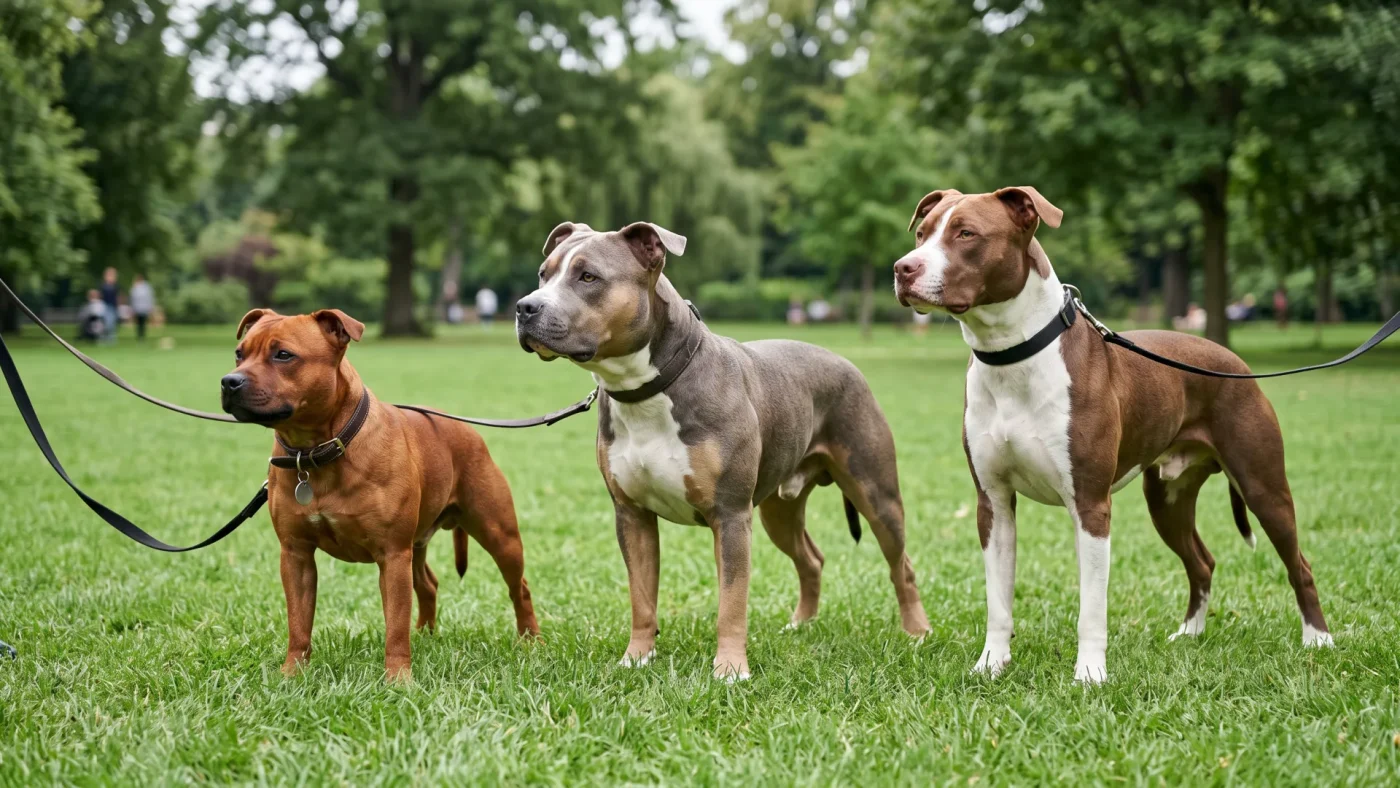
If nobody has yet asked you “Is that a pit bull?” while you were out walking your English Staffordshire Bull Terrier (Staffordshire Bull Terrier), the breed known in Turkey simply as the “English Staff”, they probably will soon. The English Staff vs pit bull question gets even more confusing once the American Staffordshire Terrier enters the picture: the three dogs come from the same root, look alike and are often sold in adverts under one another’s names.
This confusion is not just a matter of names. In Turkey these dogs have different legal statuses, and a puppy sold under the wrong breed name can put its owner in a difficult position, both legally and in terms of expectations. We covered the breed’s general characteristics in our English Staffordshire Bull Terrier guide. In this article we focus only on the points that set the three breeds apart, based on the official breed standards.
A Common Root: The “Bull and Terrier” Dogs
All three breeds share the same starting point: the dogs known as “bull and terriers”, produced in Britain by crossing bulldogs with terriers. The aim was to combine the terrier’s boldness with the bulldog’s strength. One branch of these dogs took its name from Staffordshire, where it was especially popular, and came to be kept apart from the other bull and terrier types.
The split began when some of these dogs travelled to America with emigrants. There they were also used on farms to catch semi-wild cattle and hogs, to hunt and to drive livestock, and over time they developed towards a larger, longer-legged build. The branch that stayed in Britain kept its compact, low-to-the-ground build. Today we are talking about three dogs that share an ancestry but have separate standards and separate stud books.
Official Recognition: Which Organisation, and When?
- English Staff (Staffordshire Bull Terrier): Recognised in 1935 by The Kennel Club (now the Royal Kennel Club). The American Kennel Club (AKC) records its year of recognition as 1974, while the United Kennel Club (UKC) gives 1975 in its own standard. The Fédération Cynologique Internationale (FCI) also recognises the breed.
- American Staffordshire Terrier (AmStaff): Recognised by the AKC in 1936 under the name “Staffordshire Terrier”, on the assurance that it would not be used for fighting. In 1972 “American” was added to its name to distinguish it from its English cousin. The FCI also recognises the breed.
- Pit Bull (American Pit Bull Terrier): The first organisation to recognise the breed was the UKC. In 1898 the UKC’s founder registered his own dog under this name as number 1. The AKC and the FCI do not recognise this breed.
One more detail matters: the AKC closed the AmStaff stud book in the 1970s. That is why not every American Pit Bull Terrier counts as an AmStaff. In everyday language, however, the word “pit bull” is often used not for a single breed but for every dog with this look. What breed a dog belongs to is shown not by its appearance but by the records of a recognised organisation.
Physical Differences: A Comparison Table of the Three Breeds
The values below are taken from each breed’s own official standard: The Kennel Club breed standard for the English Staff, the AKC and FCI standards for the AmStaff, and the UKC’s American Pit Bull Terrier standard for the pit bull. Measurements given in inches and pounds have been converted approximately to centimetres and kilograms.
| English Staff | AmStaff | Pit Bull | |
|---|---|---|---|
| Height at the shoulder | 36-41 cm | Males approx. 46-48 cm, females 43-46 cm | Males approx. 46-53 cm, females 43-51 cm (the UKC gives this as an approximate guide) |
| Weight | Males 13-17 kg, females 11-15.4 kg | No weight given in the standard; weight should be in proportion to height | Males approx. 16-27 kg, females 14-23 kg |
| General build | Compact and low to the ground; length of back close to height at the shoulder | Stocky; should not be long-legged or slight in build | Medium-sized and athletic; body slightly longer than it is tall; should not look bulky |
| Head | Short and deep; broad skull, very pronounced cheek muscles, short foreface | Medium length and deep; broad skull, pronounced cheek muscles | Medium length; broad, flat skull, wide and deep muzzle; a blunt wedge when viewed from the front |
| Ears | Rose or half-pricked; full drop or pricked ears highly undesirable. Cropped ears do not appear in the standard. | Cropped or uncropped; uncropped preferred | Natural or cropped; no preference stated |
| Tail | Medium length, low set, likened to an old-fashioned pump handle | Short, low set, not docked | Relatively short, low set, thick at the base |
| Coat | Smooth, short and close | Short, close, stiff to the touch and glossy | Glossy, smooth, close and moderately stiff |
| Colour | Red, fawn, white, black, blue and any of these with white; any shade of brindle. Any other colour is unacceptable. | Any colour; all white, more than 80 per cent white, black and tan, and liver are not to be encouraged | Any colour except merle |
Height and Weight: The Most Reliable Clue
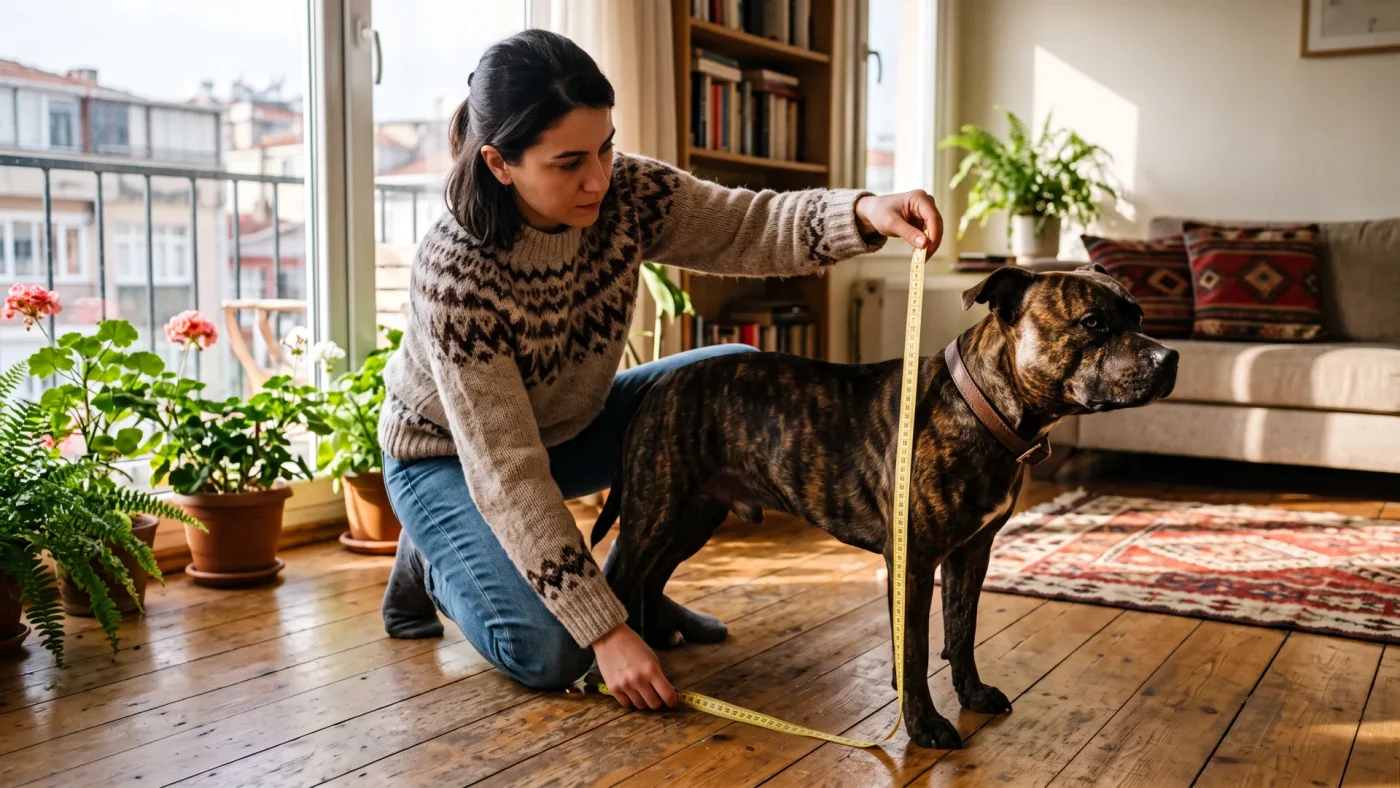
Size is the most concrete way to tell the three breeds apart, and it is also where the AmStaff vs English Staff difference is clearest: 41 cm, the English Staff’s upper limit, does not even reach the bottom of the range given for AmStaff females. For the pit bull, the weight range given for males goes up to around 27 kg, whereas the upper limit for an English Staff male is 17 kg. In an adult dog, the difference is as clear as a tape measure and a set of scales can make it.
Head and Face
The English Staff’s head is the shortest and deepest of the three breeds; the foreface is short and the cheek muscles are very pronounced. In the AmStaff and the pit bull the head is of medium length and the muzzle is longer. The difference stands out in adults, but in puppies and crossbreeds it is hard to judge by eye.
Ears
The English Staff standard describes natural ears only: rose-shaped or half-pricked. The AmStaff and pit bull standards, by contrast, allow cropped ears. In Turkey this is a legal matter even before it is a question of standards: Article 8 of Law No. 5199 on Animal Protection prohibits cutting the ears and tails of pets to change their appearance. Procedures a veterinarian considers necessary on medical grounds are exempt.
Temperament Differences: What Do the Standards Say?
Breed standards also describe temperament, but that description is a definition of the ideal dog, not a guarantee. Here is what the three standards emphasise:
- English Staff: Courage and tenacity, high intelligence and affection, especially with children. The standard describes the breed as “bold, fearless and totally reliable”.
- AmStaff: A dog keenly aware of its surroundings, whose courage is proverbial. The FCI standard disqualifies aggressive or overly shy dogs.
- Pit Bull: Strength, confidence and zest for life. The UKC standard states that aggression towards humans is uncharacteristic of the breed, and that it does not make a good guard dog because it is extremely friendly, even with strangers.
As you can see, all three standards describe a people-oriented dog with a weak guarding instinct. Attitude towards other dogs, on the other hand, is a tendency left over from their shared history: the English Staff is known to be selective with other dogs, and the UKC standard openly notes that some degree of intolerance towards other dogs may be seen in the pit bull. This tendency does not appear in every dog, and where it does, it can be managed.
How a dog behaves depends less on its breed name than on its parents’ temperament, how it spent its first weeks, how well it was socialised and how its owner manages it. Two dogs of the same breed can be very different from each other. We discuss this separately in Are English Staffies dangerous?, and for your puppy you can also take a look at our socialisation guide.
Legal Status in Turkey: Similar Looks, Different Outcomes
Law No. 5199 prohibits the breeding, ownership and sale of dangerous animals designated by the Ministry. Provisional Article 3 of the law explicitly names the Pitbull Terrier and its crosses. The American Staffordshire Terrier and the American Bully were also brought within this scope by Circular No. 2021-48 of the Ministry of Agriculture and Forestry, dated 7 December 2021. The English Staff is not on this list.
The word “crosses” in the law matters in practice: a dog sold as an English Staff but with pit bull in its ancestry could bring its owner within the scope of the ban without them realising it. For the details and the current situation, see our article Is the English Staffordshire Bull Terrier a banned breed in Turkey?
How Can You Spot Other Dogs Sold as “English Staff” in Adverts?
In some adverts, AmStaffs, pit bulls or their crosses may be sold under the name “English Staff”. None of the signs below is conclusive proof on its own, but if several of them come together, you should stop and ask questions.
- The parents’ measurements are outside the standard. If the mother’s or father’s shoulder height is clearly over 41 cm and their weight is well above 20 kg, those measurements fit the AmStaff and pit bull range rather than the English Staff.
- Size class labels. Terms such as “XL”, “large type” or “jumbo” mean nothing for the English Staff. The standard has a single size range; no separate large type is defined.
- Cropped ears or a docked tail. The English Staff standard describes natural ears and an undocked tail. In Turkey, cosmetic cropping and docking are banned anyway. An “English Staff” with cropped ears is two separate warning signs, one about the breed and one about the law.
- Long legs or excessive bulk. The English Staff is balanced and compact. A dog that is noticeably long-legged or, at the other extreme, very wide, short-legged and bulky may carry traces of another breed.
- A non-standard colour. The merle pattern in particular does not occur in the English Staff. We go through which colours fit the standard, one by one, in our article on English Staffy colours.
- A breed claim without papers. If there is no pedigree, if you are told it “will come later”, or if the mother and father cannot be shown in any way at all, there is no way left to verify the breed claim. In Turkey, the pedigree should be issued by a recognised organisation such as the Federation of Dog Breeds and Cynology (Köpek Irkları ve Kinoloji Federasyonu, KIF), a member of the FCI.
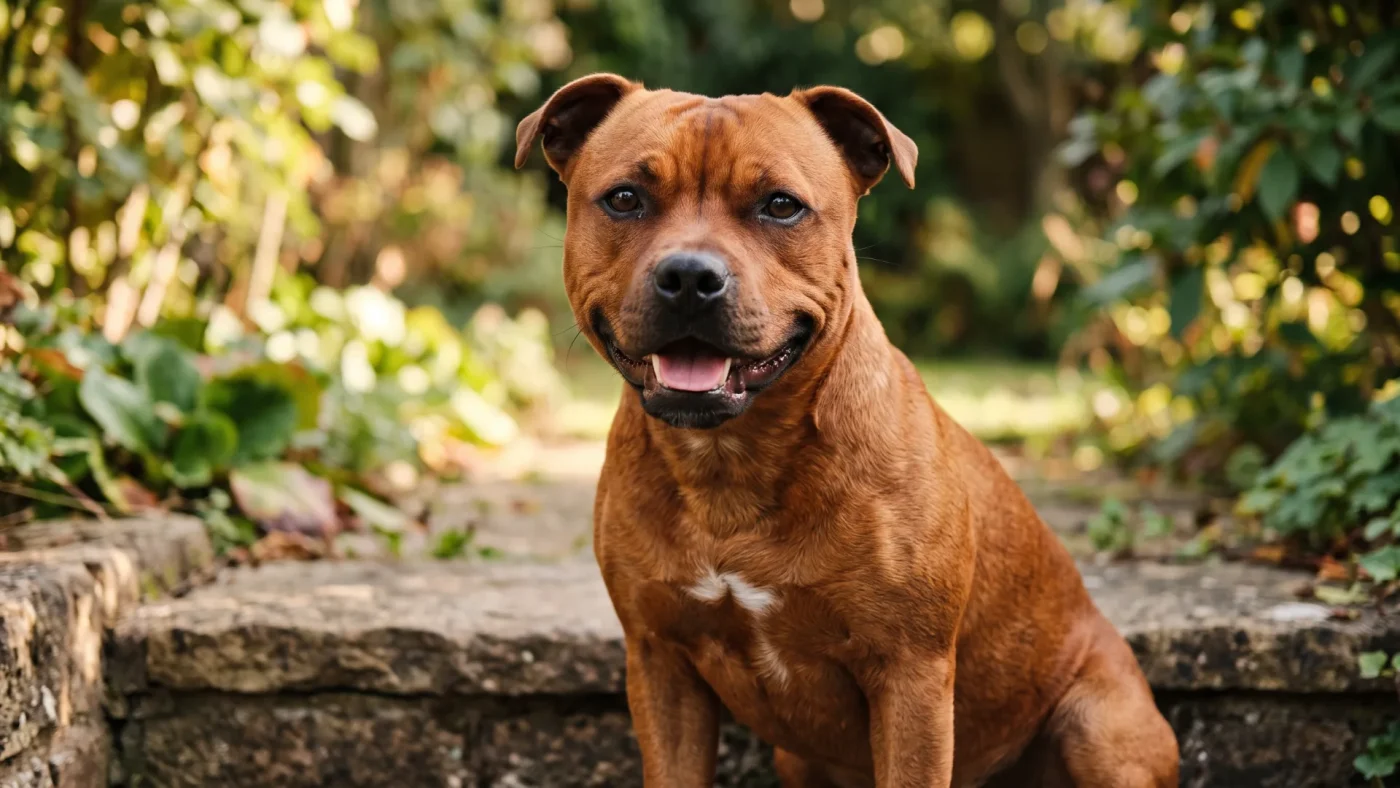
Remember that these differences are very hard to see by eye in eight-week-old puppies. The strongest evidence is not the puppy itself but its parents and its papers. When you are assessing a seller, our guide to choosing a reliable breeder and our list of questions to ask the seller when buying a puppy will help.
Where Does the American Bully Fit In?
The American Bully is a separate breed developed from the American Pit Bull Terrier, with the American Bulldog, the English Bulldog and the Olde English Bulldogge also playing a part in its development. It was recognised by the UKC on 15 July 2013. The UKC standard describes the breed in three sizes: Pocket, Standard (together with the lighter-built Classic type) and XL.
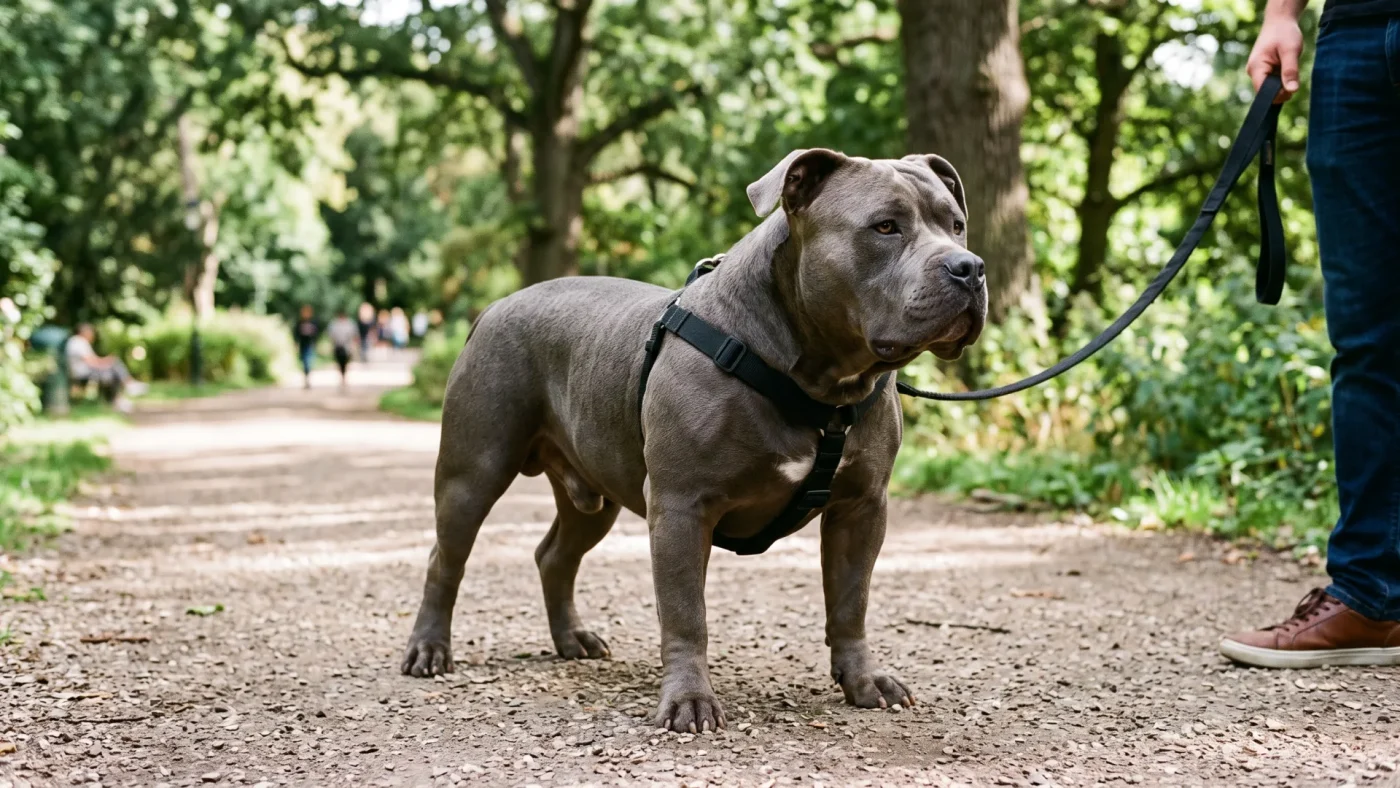
The Bully is neither an English Staff nor an AmStaff; it is a broader-chested, heavier-boned and bulkier dog. If a puppy that is noticeably wider, shorter-legged and bigger-headed than an English Staff is being offered as a “Staff”, consider the possibility of bully ancestry as well. As mentioned above, the American Bully is also covered by the ban in Turkey under Circular No. 2021-48.
Frequently Asked Questions
Are the English Staff and the Pit Bull the Same Breed?
No. The difference between the pit bull and the Staffy lies not in the root but in what came later: both descend from the same bull and terrier line, but the English Staff developed in Britain as a compact breed, while the pit bull developed in America with a larger build. They have separate standards and separate registration bodies.
What Is the Most Obvious Difference Between the AmStaff and the English Staff?
Height. The English Staff stands 36-41 cm, while the AmStaff is approximately 46-48 cm in males and 43-46 cm in females. The AmStaff’s head is also longer, and its standard allows cropped ears.
Can You Tell the Breed While It Is Still a Puppy?
It is very hard to tell by eye. The most reliable evidence of a puppy’s breed is its mother and father, their measurements and a pedigree issued by a recognised organisation.
Can an English Staff Have Cropped Ears?
The breed standard describes natural ears only, and cosmetic ear cropping is banned in Turkey. Always question the breed and history of a dog with cropped ears.
Is the American Bully a Type of Staff?
No. The American Bully is a separate breed developed from pit bull stock and was recognised by the UKC in 2013. Its common ancestor with the English Staff lies in the distant past.
The three breeds may share a root, but today they are dogs with different sizes, different standards and, in Turkey, different legal statuses. When you are deciding on a puppy, look not at the breed name in the advert but at the parents’ measurements, the paperwork and the answers the seller gives to your questions.

Most Read Articles
Bought a Sick Puppy in Turkey? Your Rights and What to Do, Step by Step
If the puppy you have just bought fell ill shortly after coming home, your first...
Oct
Fungal Infections in Dogs (Dermatomycosis): Symptoms, Diagnosis and Treatment
Fungal infections in dogs, known in veterinary terms as dermatomycosis, are infections of the skin,...
Sep
English Staffordshire Bull Terrier Guide: Traits, Temperament, Health and Care
The English Staffordshire Bull Terrier (officially the Staffordshire Bull Terrier, “Staffy” for short, and usually...
Oct