


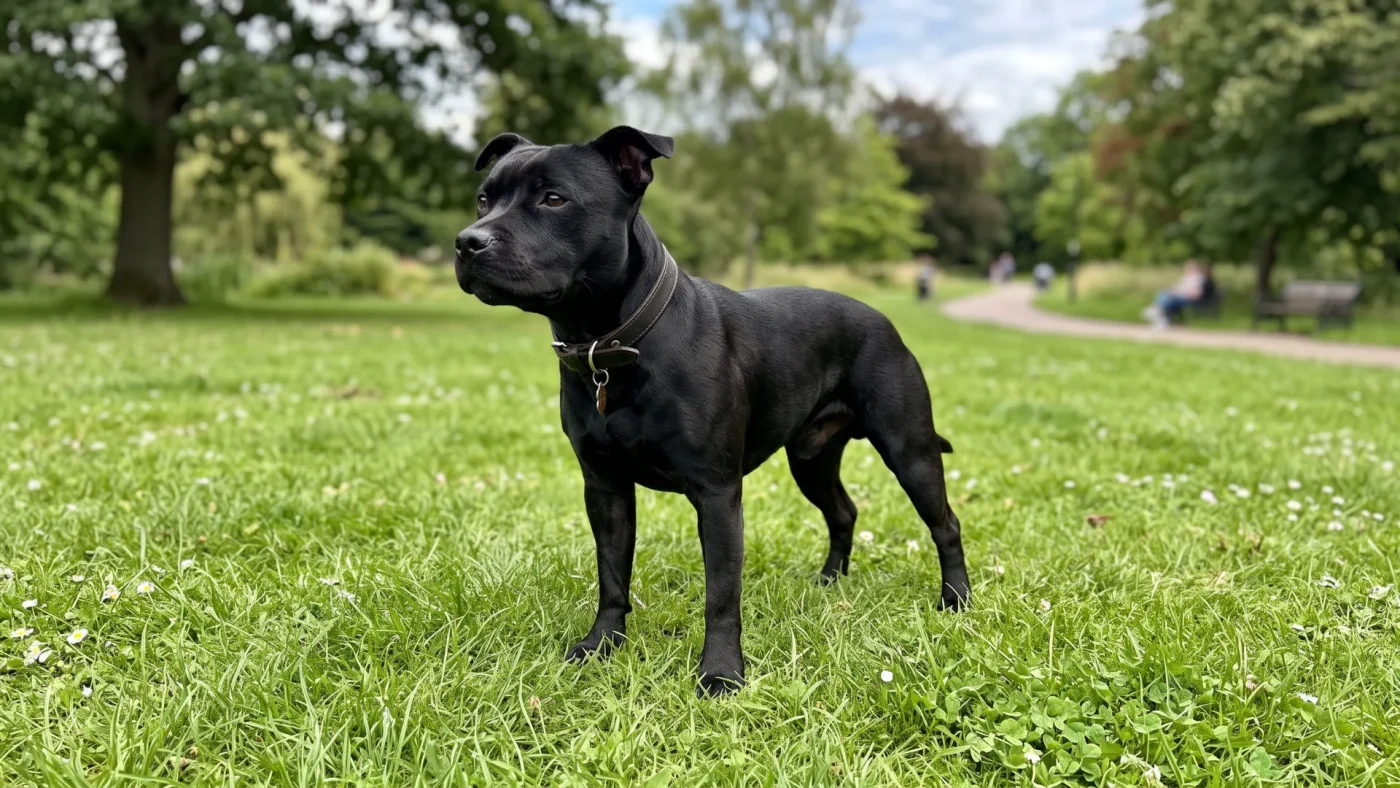
The English Staffordshire Bull Terrier (officially the Staffordshire Bull Terrier, “Staffy” for short, and usually called the “English Staff” in Turkey) is one of the most talked-about and most misrepresented dog breeds in Turkey. In adverts you read lines like “very easy to train”, “hardly sheds at all” and “gets on with every dog”; out on the street you are asked “Is that a pit bull?” Neither tells the real story.
We put this guide together as owners who have lived with this breed for years and ran into serious problems when we got our dogs. Our aim is not to put you off the breed. Quite the opposite: we want to gather everything you need to know before bringing an English Staffy home in one place, stripped of marketing language. From the breed standard to hereditary diseases, from temperament to legal status, all the way to the questions you should ask when choosing a puppy.
The English Staffy at a Glance
- A small-to-medium, very muscular terrier breed that originated in England. It was recognised by the Kennel Club in 1935.
- Extremely devoted to people; it does not like being left alone and does not always get on with other dogs.
- Height at the shoulder is 36-41 cm; weight is 13-17 kg for males and 11-15.4 kg for females.
- Skin allergies are common in this breed. Blue dogs carry a risk of colour dilution alopecia (CDA).
- It is not on Turkey’s banned breed list, but it is often confused with the American Staffordshire Terrier and the pit bull.
- When buying a puppy, do not make a decision until you have seen the parents’ DNA test results and the vaccination and microchip records.
English Staffy Breed Profile
| Official name | Staffordshire Bull Terrier |
| Names used in Turkey | İngiliz Staff, İngiliz Staffordshire, English Staff, Staffy |
| Origin | England (Staffordshire) |
| Official recognition | 1935, The Kennel Club (UK) |
| Height (at the shoulder) | 36-41 cm |
| Weight | Males 13-17 kg, females 11-15.4 kg |
| Life expectancy | 12-14 years in most sources |
| Coat | Short, dense and smooth; sheds seasonally and all year round |
| Energy | High |
| Trainability | Moderate; clever but stubborn, needs patience and consistency |
| Tolerance of being left alone | Low |
| Legal status in Turkey | Not on the banned breed list |
Where Does the English Staffy Come From?
The English Staffy’s story begins in the industrial areas of 19th-century England, around Staffordshire and Birmingham. These dogs were produced by crossing the Bulldog with various terrier breeds and, sadly, in their early days they were used for bull-baiting and dog fighting. After such events were banned in England in 1835, the breed gradually became a household dog for working-class families.
The breed gained its official identity when the Kennel Club recognised it in 1935. The branch of the same dogs that was taken to America was developed in a different direction, to be bigger and taller, and became the separate breed known today as the American Staffordshire Terrier (AmStaff). Much of the confusion in Turkey stems from this shared history.
Physical Characteristics of the English Staffy
Height and Weight
For its size, the English Staffy is a surprisingly heavy and muscular dog. According to the Kennel Club standard, the ideal height at the shoulder is 36-41 cm; weight is 13-17 kg for males and 11-15.4 kg for females. The standard asks for height and weight to be in proportion to each other. If a long-legged dog that easily tops 20 kg is being sold to you as a “big English Staff”, it is either from a line outside the breed standard or there is a chance it is crossed with another breed.
Head and Body
A broad, short skull, pronounced cheek muscles, a short muzzle and a strong jaw are the breed’s most recognisable features. The body is short and sturdy, the chest is wide and the front legs are set well apart. This build gives the dog a low centre of gravity and a very powerful stance. It also means that an adult Staff pulling on the lead is not as easy to control as people think.
English Staffy Colours
The breed standard accepts the following colours: red, fawn, white, black and blue, along with any of these mixed with white; plus brindle (tiger-striped) in any shade, and brindle with white. Under the standard updated in November 2025, every other colour, including black and tan and liver, is “unacceptable”; colours marketed as “rare”, such as merle, also fall into this group. We cover each colour in detail in our English Staffy colours article.
Colour tells you nothing about a dog’s value or health. But there is one important point you need to know about the blue English Staffy in particular: careless blue x blue pairings made to produce this colour can increase the likelihood of permanent skin and coat problems such as colour dilution alopecia (CDA). Because blue puppies sell for higher prices, these pairings are, unfortunately, an attractive option for some.
Temperament: What Is an English Staffy Really Like?
It may look tough, but the English Staffy’s most striking trait is its devotion to people. This is a dog that never leaves its owner’s side, gets more excited the more attention it receives and, at home, often behaves more like a child than an adult. Even so, every dog is an individual; the points below are general tendencies of the breed, not guarantees.
- Extremely attached to people: It does not like being alone. A Staff left on its own for long hours may develop separation anxiety, destroy things and bark.
- Selective with other dogs: It can have low tolerance for other dogs, especially those of the same sex. That is why early, well-managed socialisation is critical.
- Energetic and playful: If its daily exercise needs are not met, that energy turns into problem behaviour at home.
- Stubborn but sensitive: It does not respond well to harsh methods; with positive reinforcement and consistency it does very well.
- Weak guarding instinct: It is usually friendly towards strangers. If you are looking for a guard dog, this is not the right breed.
The “Nanny Dog” Myth
The “nanny dog” label often attached to the English Staffy has no history backed by historical documents; it is a relatively recent, romantic tag. The breed’s tolerance of children is genuinely high, but no dog, whatever its breed, should be left unsupervised with young children.
What You Hear in Adverts and What Really Happens
We have set some of the claims we often heard in breeders’ videos and adverts while getting our dogs side by side with the experience of owners who live with these dogs. We describe the problems we went through ourselves in detail on our Complaints page.
| Common claim | The reality |
|---|---|
| “It only sheds twice a year, and very little.” | A short coat does not mean little shedding. English Staffies shed all year round, and noticeably more at seasonal changes. Be ready to find short, prickly hairs on your clothes and sofa. |
| “It is very easy to train.” | It is clever but stubborn. Toilet training, lead training and meeting other dogs take months of consistent effort. |
| “Even a child can walk it easily.” | An adult Staff is very strong for its size. It is not safe for a child to hold a Staff that pulls on the lead or reacts to another dog. |
| “It gets on with every dog.” | The breed is known for being selective with other dogs. Reactivity is one of the most common problems owners face. |
| “It is a hardy breed with no health problems.” | It is a hardy breed, but skin allergies are common, DNA tests are needed for certain hereditary diseases and blue dogs carry a risk of CDA. |
| “Blue is a rare and valuable colour.” | Blue is a standard colour, not a rare variety. A high price is not a sign of health or quality. |
Are English Staffies Dangerous?
The English Staffy is not by nature an aggressive breed towards people; quite the opposite, it is known for its people-focused character. But it is a strong dog and can be reactive towards other dogs. What really decides whether a dog is dangerous is its genetic temperament, how it was socialised as a puppy and how its owner manages it. An unhealthy, carelessly bred, unsocialised puppy raised in poor conditions can cause problems in any breed.
English Staff vs American Staffordshire Terrier vs Pit Bull
| English Staff | American Staffordshire Terrier | Pit Bull | |
|---|---|---|---|
| Origin | England | USA | USA |
| Build | Compact, low-set, 36-41 cm | Bigger and taller | Bigger and more athletic |
| Official recognition | Kennel Club and FCI | AKC and FCI | UKC; not recognised by the AKC or FCI |
| Status in Turkey | Not on the banned list | Banned under the 2021 circular | Banned by law |
This difference has a practical consequence: your dog’s breed may be questioned out on the street or if a complaint is made. Always keep the pedigree certificate, microchip and registration details showing that your dog is an English Staff within easy reach. We explain how to tell the three breeds apart in our English Staff vs AmStaff vs Pit Bull article, and how to manage the breed in a home with children or in a block of flats in Are English Staffies dangerous?
Is the English Staffy Banned in Turkey?
No. Law No. 5199 on Animal Protection (Hayvanları Koruma Kanunu) prohibits the breeding, ownership, sale and advertising of “dangerous animals” as designated by the Ministry (article 14/1-l). Provisional article 3 of the law explicitly lists the Pitbull Terrier, Japanese Tosa, Dogo Argentino and Fila Brasileiro, along with their crosses. A circular issued by the Ministry of Agriculture and Forestry, No. 2021-48 dated 7 December 2021, added the American Staffordshire Terrier and the American Bully to this list.
The Staffordshire Bull Terrier, that is the English Staffy, is not on this list; it can be legally owned in Turkey. Because legislation can change from time to time, we recommend confirming the current list with your provincial or district directorate of agriculture and forestry (İl/İlçe Tarım ve Orman Müdürlüğü). For details, see our article Is the English Staffordshire Bull Terrier a banned breed in Turkey?
English Staffy Health Problems
The English Staffy is generally a hardy breed, but it is prone to certain problems. Knowing them helps you both choose the right puppy and notice problems early. We cover every topic in detail in our article on Staffordshire Bull Terrier health issues.
Skin Problems and Allergies
The skin is where owners of this breed run into problems most often: itching, redness, paw licking, ear infections and recurring fungal infections. Environmental and food allergies are common and often need lifelong management. For symptoms and treatment options, see our articles on English Staffordshires and allergies and fungal infections in dogs. You can also read the stories of dogs that have to take medication constantly because of their allergies in the owner experiences section.
Blue Coats and Colour Dilution Alopecia (CDA)
Colour dilution alopecia is a hereditary condition that affects the hair follicles of dogs with diluted colours such as blue. The puppy’s coat looks normal at birth; signs usually appear months or even years later as thinning along the back, permanent hair loss and recurring skin infections. There is no definitive cure; it is managed. For details, see our colour dilution alopecia (CDA) article and the first-hand experience shared by the owner of a dog living with CDA.
Hereditary Diseases and DNA Tests
There are two important hereditary diseases in the English Staffy for which carrier status can be identified with a DNA test. The Kennel Club recommends these tests, along with additional screening, for dogs that will be used for breeding:
- L-2-HGA (L-2-hydroxyglutaric aciduria): A metabolic disease that affects the nervous system; it can cause seizures, loss of balance and changes in behaviour.
- Hereditary cataract (HC-HSF4): An eye disease that can start at a young age and progress to loss of sight.
- Eye and elbow screening: Regular eye examinations and elbow dysplasia screening are recommended for breeding dogs.
A responsible breeder should be able to show you the parents’ results for these tests in writing. “That never happens with our dogs” is not a test result.
Other Things to Keep an Eye On
- Skin lumps: Skin tumours, especially mast cell tumours, are seen more often in this breed. Show any new lump on the skin to your vet without waiting.
- Weight: This is a breed with a big appetite; excess weight harms the joints and the skin.
- Digestion: Dogs with sensitive stomachs are common. We describe the signs to watch for in our gut health in dogs article.
- Thyroid: If lethargy, unexplained weight gain and hair loss appear together, ask your vet for a thyroid check. We have gathered the symptoms in our article on hypothyroidism in dogs.
- Urinary tract: If you notice frequent urination, straining or blood in the urine, do not wait. Our article on urinary tract infections in dogs explains the symptoms and what the vet will look for.
English Staffy Care and Feeding
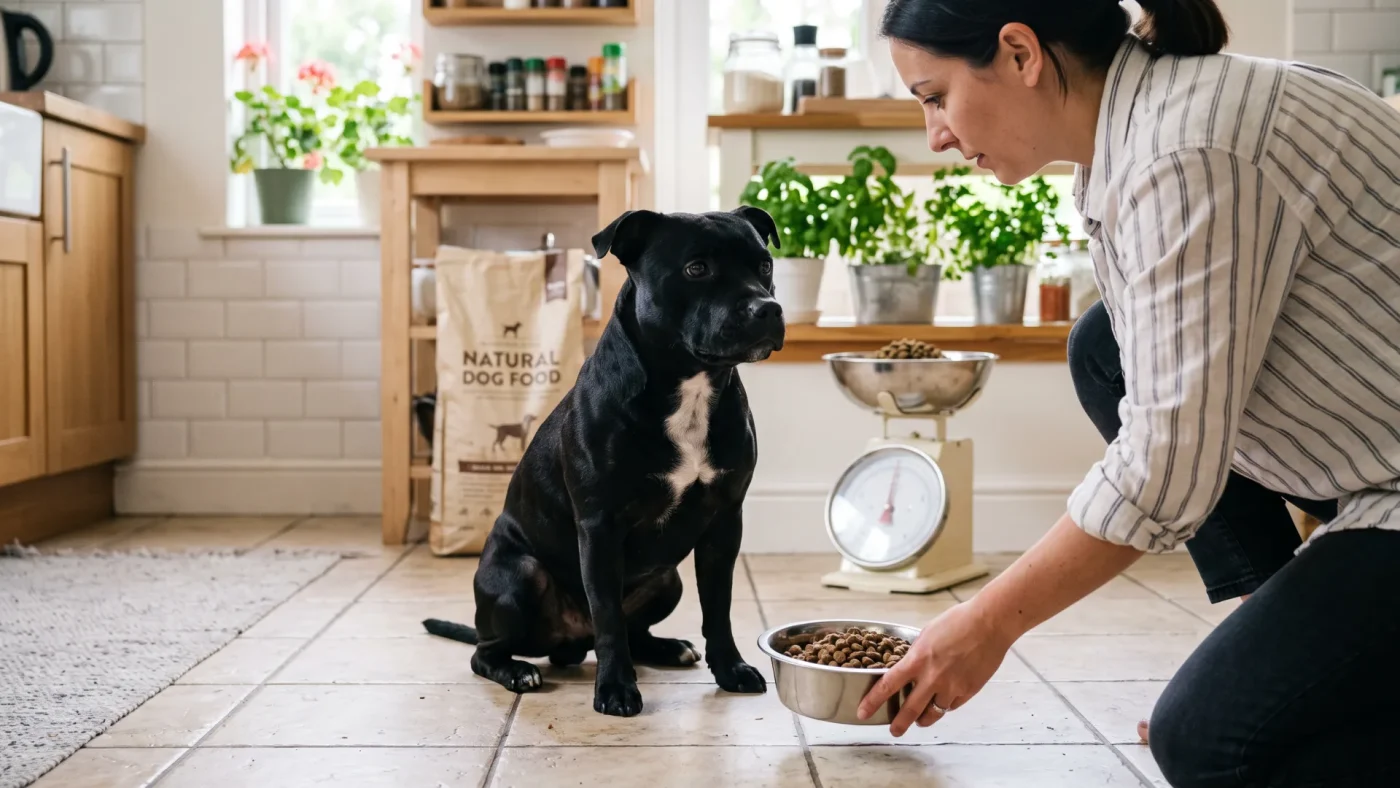
- Coat: Brushing once or twice a week with a rubber brush reduces dead hair. Frequent bathing can dry out the skin; choose a shampoo made for dogs that does not dry the skin. We explain how much they shed and which kinds of hair loss are a sign of illness in Do English Staffies shed?
- Exercise: At least two walks a day plus games that work the mind are essential. Because of its dense muscle and relatively short muzzle, it can tire quickly in the heat; in summer, move walks to the cooler hours.
- Feeding: Choose a food with good-quality protein that helps maintain muscle. For dogs with allergies, plan any change of food together with your vet.
- Teeth and nails: Regular tooth brushing and a monthly nail check should not be neglected.
Training and Socialisation
The English Staffy responds to a relationship, not to pressure. A harsh tone of voice and punishment damage trust in this breed; short, playful, reward-based sessions get much better results. The first weeks of puppyhood are the most valuable time for meeting different people, sounds, places and calm dogs. Our articles on socialising an English Staff puppy, English Staffy puppy care and stopping chewing can guide you.
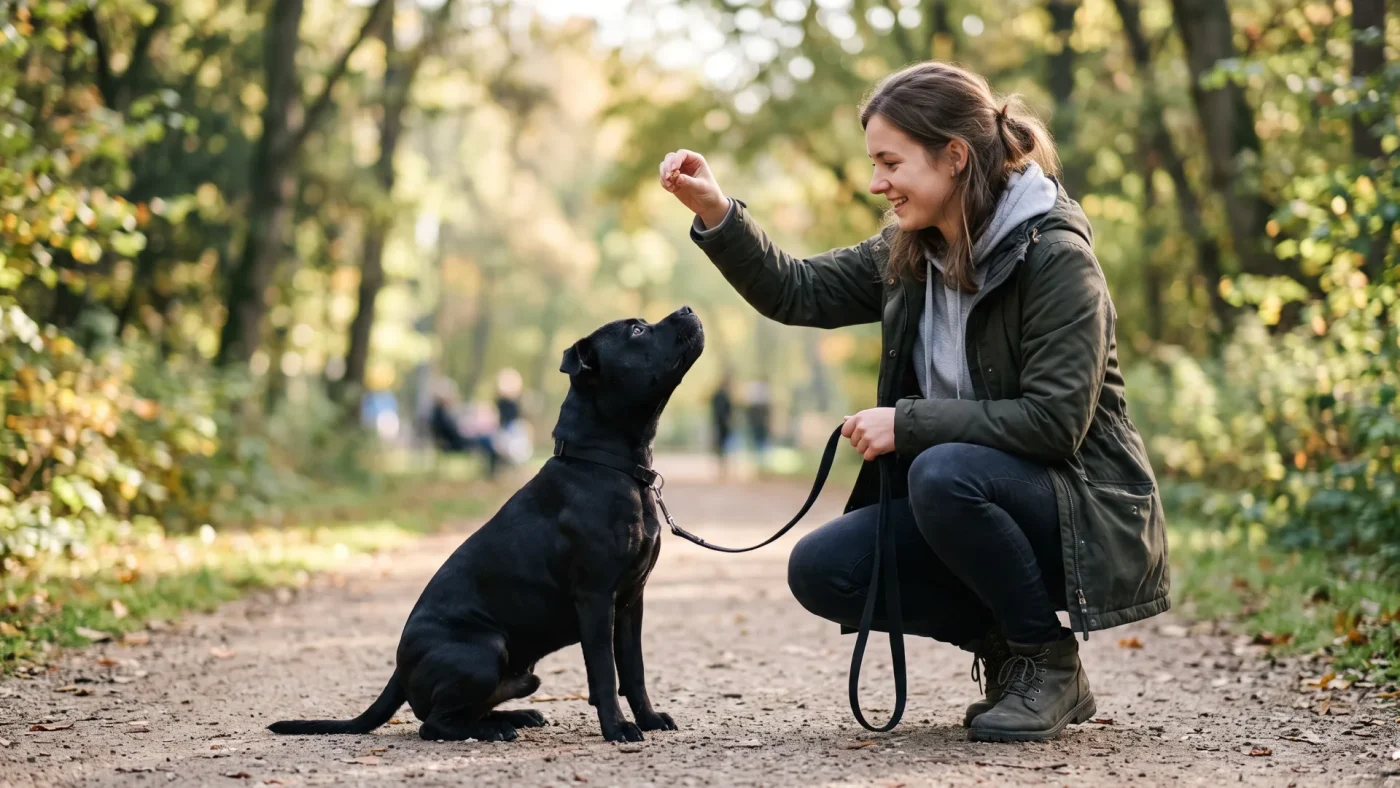
Remember: where and how a puppy spends its first weeks plays a decisive role in whether its training goes smoothly or not. Puppies raised in crowded conditions or in cages, with little human contact, are more likely to have problems with toilet training, eating faeces and reactivity.
English Staffies in Flats and Homes with Children
An English Staffy can live in a flat: it is not a breed that barks a lot, and it can be calm indoors. But that calm is only possible when its daily needs for exercise and attention are met. In a household where nobody is home all day, this breed will be unhappy. In homes with children, the breed’s tolerance is high, but its strong, lively build can knock small children over without meaning to. Constant supervision, a quiet space the dog can retreat to and teaching children how to interact with the dog properly are always necessary.
Checklist for Buying an English Staffy Puppy
Most of the problems we had with the dogs we got came from questions that were not asked on handover day. Before you bring a puppy home, make sure you ask for the following:
- See the mother and father. See both if possible; if not, at least see the mother in her own environment. Pay attention to their temperament and their skin.
- Ask for the test results. See the parents’ L-2-HGA and HC DNA test results in writing.
- Check the pedigree. The pedigree should be issued by a recognised body, such as the Federation of Dog Breeds and Cynology (Köpek Irkları ve Kinoloji Federasyonu, KIF), Turkey’s FCI member.
- Vaccination card and microchip. The puppy should have had the vaccinations appropriate for its age, been microchipped and been registered.
- Check the skin at handover. If there are hairless patches, sores, redness, dandruff or itching, ask about it before handover and have it put on record.
- Ask about any medication. If you are given medicine, a spray or tablets at handover, ask in writing what they are for and which diagnosis they are based on.
- An independent vet examination. In the first days after handover, have the puppy examined by a vet who is independent of the seller.
- A written contract. The health guarantee, return conditions and the period the seller is responsible for should be in writing. Verbal promises are of no use once a problem appears.
- Ask how the puppy was raised. Indoors or in a cage? How much time did it spend with people? Has toilet training started?
- Talk to real owners. Do not rely only on the videos the seller shares; look at the experiences of people who have bought a dog from that breeder.
For a more detailed guide, read our English Staffy adoption guide, our article on choosing a reliable breeder and the 15 questions to ask the seller when buying a dog. If you have bought a sick puppy, we have gathered the steps you need to take in a separate article.
What Determines the Price of an English Staffy?
English Staffy puppy prices vary a great deal by breeder, city and period, so we do not give figures here. Instead, look at what the price should cover: the parents’ health tests, a proper pedigree, age-appropriate vaccinations, microchip and registration, the conditions the puppy was raised in and support after handover. If the only thing pushing the price up is colour (for example, the puppy being “blue”), that is a marketing choice, not a sign of quality. A high price does not guarantee a healthy dog; a cheap puppy is usually a sign of costs that were skipped.
Real Owner Experiences
On this site, we collect the experiences of people who got an English Staffy, told in their own words, about what they went through after handover: allergies, CDA, skin infections, training and behaviour problems, and their dealings with the seller. Reading these stories before you get a puppy will show you much more clearly which questions you need to ask. Read all owner experiences.
Frequently Asked Questions
How Long Do English Staffies Live?
Most sources give an average life expectancy of 12-14 years. Dogs that come from healthy parents, are kept at their ideal weight and have regular vet check-ups reach the upper end of this range more easily.
How Much Does an English Staffy Weigh?
According to the breed standard, adult males weigh 13-17 kg and females 11-15.4 kg. Height is around 36-41 cm.
Do English Staffies Shed?
Yes. Because the coat is short, it does not come out in clumps the way a long-haired breed’s does, but it sheds all year round and shedding increases at seasonal changes. If there is more shedding than usual, bald patches or itching, talk to your vet about allergies, fungal infection or CDA.
Is the English Staff a Pit Bull?
No. The English Staff is a separate breed recognised by the Kennel Club and the FCI. The pit bull, on the other hand, is a type with no single standard and is not recognised by the FCI. Although the two share the same “bull and terrier” roots, they are different dogs.
Is the English Staff Banned in Turkey?
No, the English Staff (Staffordshire Bull Terrier) is not one of the banned breeds. To avoid your dog being mistaken for an American Staffordshire Terrier, it is a good idea to keep its pedigree and registration documents.
Can an English Staffy Be Left Home Alone?
It can get used to short periods, but it is not a breed suited to being alone for long hours. If you work full-time away from home, arrange for someone to walk it during the day or plan a routine that shortens the time it spends alone.
Should I Get a Male or a Female English Staffy?
Males are usually bigger and more muscular and can be more reactive towards other male dogs. Females are a little smaller, but they too can be intolerant of other females. If there is already a dog at home, a puppy of the opposite sex usually makes for a more harmonious start. More than sex, it is the puppy’s temperament and its parents’ character that make the difference.
In the right conditions, the English Staffy is one of the most loyal and most fun companions a family can have. Everything in this guide was written to help you put those right conditions in place from the start: realistic expectations, a healthy puppy and a responsible source.

Most Read Articles
Do English Staffies Shed? Shedding, Grooming and Allergy Facts
Do English Staffies shed? Yes, they do. A short coat does not make the line...
Oct
Colour Dilution Alopecia in English Staffordshire Bull Terrier
The English Staffordshire Bull Terrier’s coat and skin condition indicate its general health. A healthy...
Apr
English Staffordshire Bull Terrier Adoption Guide: What to Know Before Getting a Puppy
Adopting an English Staffordshire Bull Terrier can look like an easy decision at first: a...
Sep