


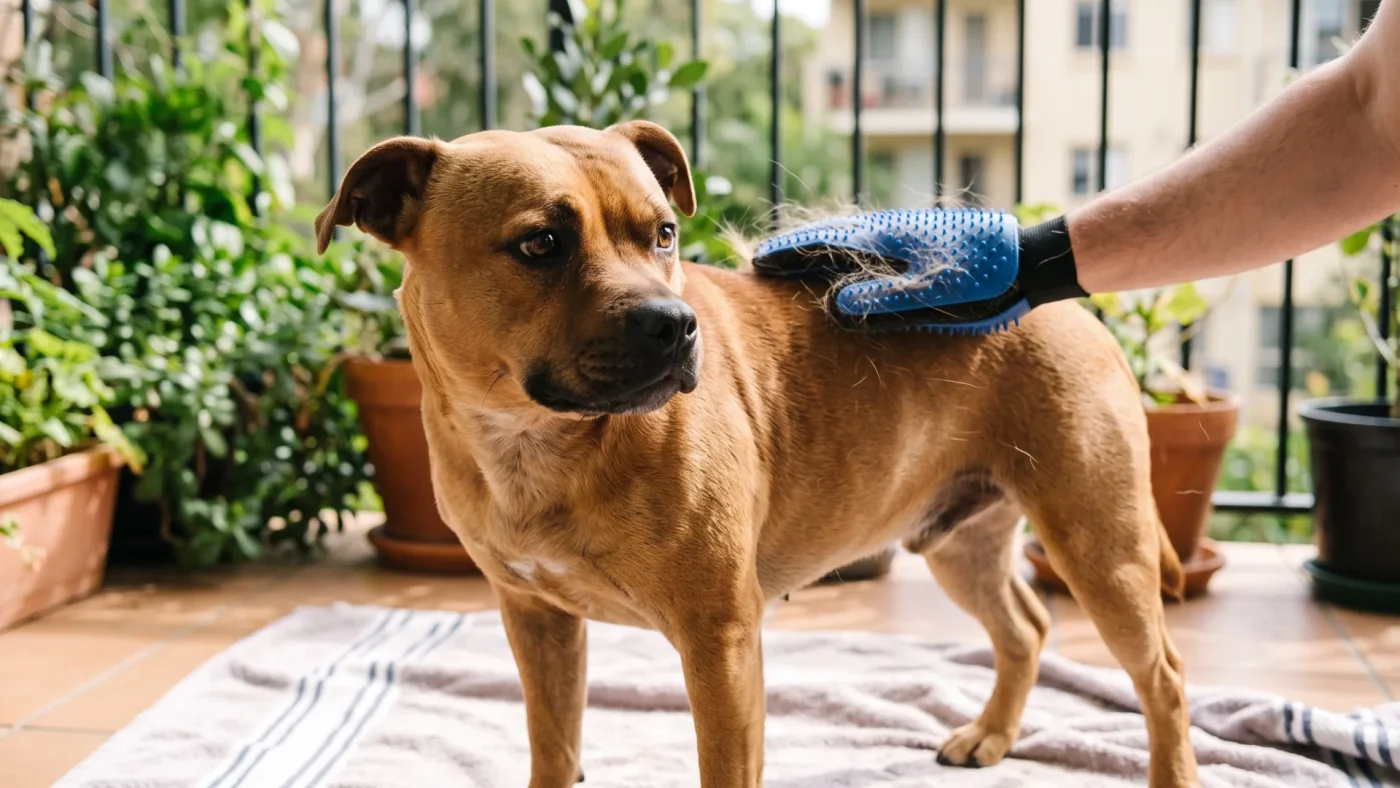
Do English Staffies shed? Yes, they do. A short coat does not make the line you often read in adverts, “hardly sheds at all”, true. The English Staffordshire Bull Terrier (Staffordshire Bull Terrier), known in Turkey as the English Staff, sheds lightly to moderately all year round, and the shedding increases noticeably when the seasons change.
In this article we look at the structure of the coat, when shedding increases, realistic expectations for families with allergies and a weekly grooming routine. Most importantly, we explain how to tell normal shedding apart from hair loss that needs a trip to the vet. For the breed’s general characteristics, see our English Staffy guide.
At a Glance
- English Staffies shed: lightly to moderately all year round, and more during seasonal changes.
- The coat is short, smooth and lies close to the skin; most sources describe it as a single coat.
- They are not hypoallergenic. In fact, no dog breed can scientifically be called hypoallergenic.
- Brushing once or twice a week with a rubber brush is enough in most homes; baths are rarely needed.
- Patchy baldness, itching, redness or scaling is not normal shedding; it needs a veterinary examination.
The English Staffy’s Coat
The Staffordshire Bull Terrier’s coat is described in a single sentence in the Kennel Club breed standard: smooth, short and close to the skin. Most sources describe the breed as having a single coat with no distinct undercoat. That is why English Staffs generally do not go through the periods seen in double-coated breeds, when the undercoat comes out in clumps.
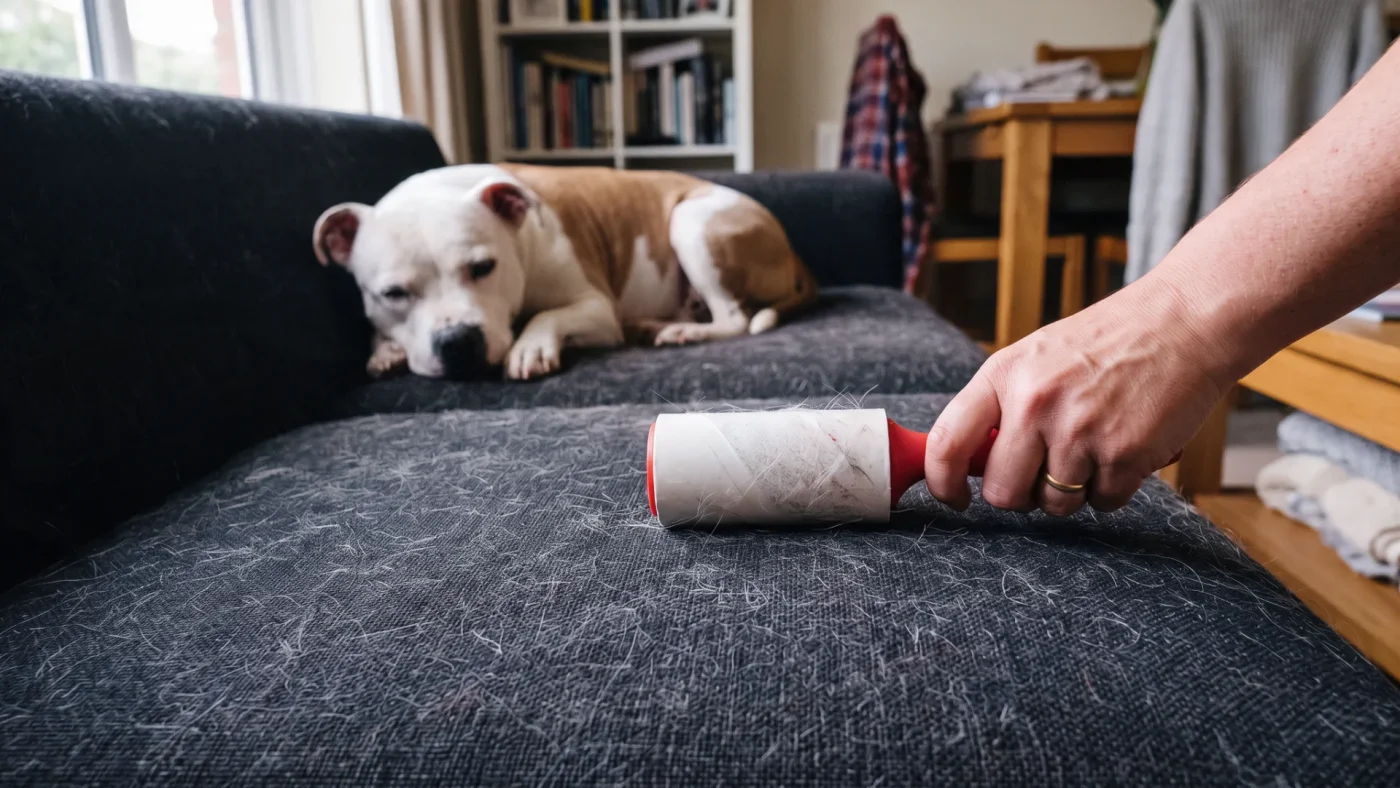
These short hairs have a problem of their own: the tips are stiff and work their way into the weave of fabric. They are not as easy to pick up as long hairs, and they show on sofa upholstery, car seats and clothes. A white or light-coloured Staffy’s hairs stand out more on dark fabric, while a black or brindle Staffy’s hairs stand out more on light fabric. A rubber glove or a lint roller is the most practical way to get these hairs off upholstery.
English Staffy Shedding: When and How Much?
The English Staffy is not a heavy shedder, but it is not a non-shedding dog either. Each hair completes its own growth cycle, falls out and is replaced by a new one, so shedding goes on all year. During the spring and autumn transitions there is usually a noticeable increase that lasts a few weeks.
In dogs, the hair cycle is influenced by ambient temperature and, to a lesser extent, by day length. In dogs that spend most of their time in a heated home, seasonal shedding may be less pronounced and spread more evenly across the year.
There are also times outside the seasons when shedding temporarily increases: after giving birth and nursing, after a feverish illness or surgery, and during periods of serious stress. This kind of shedding usually affects the whole body, and the coat grows back over time. If shedding goes on for weeks and the hair does not grow back, talk to your vet.
Are English Staffies Hypoallergenic?
Because of its short coat, this breed is often said to suit people with allergies; that is not true. The English Staff is not a hypoallergenic breed. The proteins that cause dog allergy are found less in the hair itself than in the dog’s skin flakes (dander), saliva and urine. The hair is a vehicle that carries these allergens all over the house.
In a study of breeds marketed as “hypoallergenic”, the level of the main dog allergen (Can f 1) in these dogs’ coats was not lower than in other dogs but actually higher, while allergen levels in the air of the homes did not differ between breeds. The researchers concluded that there is no evidence for classifying any dog breed as hypoallergenic.
Realistic Advice for Families with Allergies
If someone in your family has a dog allergy, make the decision before you bring a dog home, not after. Having to give a dog back because of an allergy is very hard on both you and the dog.
- See an allergy specialist first and get tested to find out whether you have a dog allergy and how severe it is.
- Before getting a puppy, spend a few hours in a home where an adult English Staffy lives and watch how you react.
- Keep the bedroom closed to the dog.
- Use a vacuum cleaner and an air purifier with a HEPA filter; cut down on carpets and fabric surfaces.
- Wash the dog’s bed and blankets once a week.
- Do the brushing outdoors and, if possible, have someone without allergies do it.
- Wash your hands after playing with the dog and avoid touching your face.
These measures reduce the allergen load in your home but do not eliminate it. If someone in the family has asthma, make the decision together with your doctor.
Weekly Grooming Routine
Brushing
Brushing in the direction of the coat once or twice a week with a rubber curry comb, a grooming glove or a soft-bristled brush collects most of the dead hair before it lands around your home. During seasonal changes, increase this to once every few days. This short coat does not need metal-toothed tools designed to remove undercoat; they can irritate sensitive skin.
Bathing
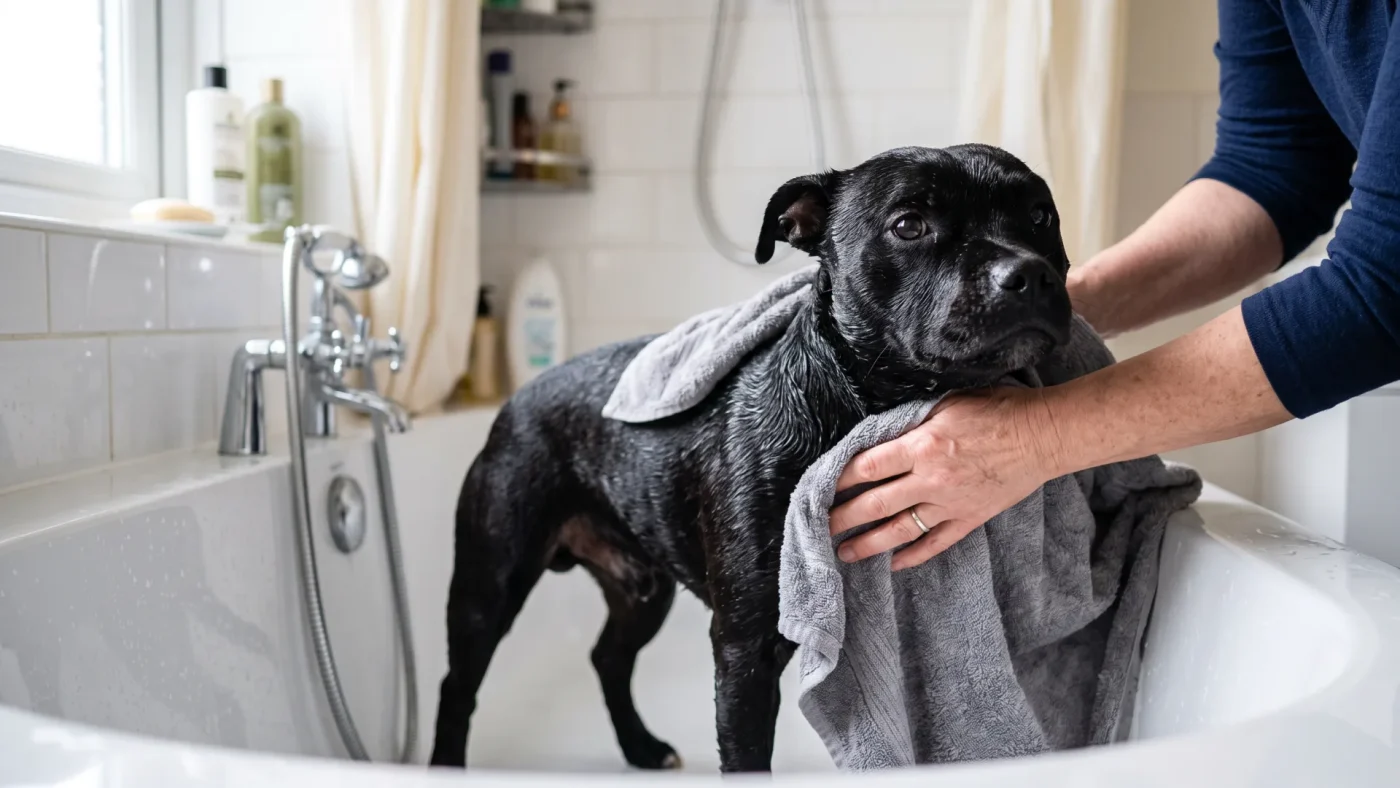
English Staffies do not need frequent baths; there is no need to wash them unless they are dirty or smell bad. Frequent bathing can strip the skin’s natural oil layer and lead to dryness. Because the skin can be sensitive in this breed, choose a shampoo with your vet’s advice and do not use human shampoo. With medicated shampoos recommended by your vet, follow the contact time and frequency exactly. After a bath, dry the dog thoroughly, especially the armpits and between the toes.
Diet and Skin Health
The shine of the coat and the resilience of the skin depend largely on diet. Good-quality protein in sufficient amounts, essential fatty acids such as omega-3 and omega-6, and adequate water intake are the foundation of a healthy coat. A dull, dry, brittle coat can be the first sign of a dietary deficiency or an underlying health problem. Talk to your vet before starting supplements or changing food; in dogs with allergies, food changes should not be made without a plan.
Parasite Protection and Skin Checks
Fleas are one of the common causes of itching and hair loss. In dogs with a flea allergy, even a few fleas can cause intense itching; the hair loss typically appears at the base of the tail and over the lower back. Use external parasite protection on the schedule your vet recommends. Use the weekly brushing as a health check too: gently part the coat against the grain to look at the skin, and check inside the ears and between the toes.
Normal Shedding or Illness?
This is what owners struggle with most. Normal shedding is the dog renewing its coat, and the skin stays healthy. With hair loss caused by illness, the skin itself often changes as well. The table below will help you make a first distinction, but it is not a substitute for a diagnosis.
| Sign | Normal shedding | Hair loss that needs attention |
|---|---|---|
| Distribution | Even shedding from the whole body, with no bald areas left behind | Bald patches here and there, round spots or symmetrical thinning on both sides of the body |
| Skin | Normal colour, clean and smooth | Redness, scaling, crusts, spots, darkening or thickening |
| Itching | None, or only occasionally | Frequent scratching, paw licking, self-biting, rubbing against the floor |
| Smell | No noticeable smell | Sour, yeasty or bad smell |
| Course | Increases during seasonal changes and eases within a few weeks | Continues regardless of the season or gets steadily worse |
| New hair | New hair grows in place of the shed hair | No hair grows in bald areas, or it grows very slowly |
| General condition | Normal appetite, energy and weight | Weight gain, lethargy, recurring ear or skin infections |
Possible Causes of Abnormal Hair Loss
The main conditions that can cause hair loss in English Staffies are listed below. More than one can be present at the same time, so do not diagnose your dog yourself on the basis of a single sign.
Allergies
Allergy is the most common skin problem in this breed. Scientific publications have reported that English Staffies and closely related bull-type breeds are predisposed to atopic dermatitis (environmental allergy); food and flea allergies can produce a similar picture. Typical signs are paw licking; itching and redness on the face, ears, armpits, groin and belly; and recurring ear infections. Hair loss is often the result of scratching and licking. For details, see our article on English Staffordshire Bull Terriers and allergies.
Fungal Infection (Dermatophytosis)
Dermatophytosis, commonly called ringworm, causes hair loss, scaling, crusting and redness; itching can be mild or marked. Lesions may appear as round bald patches, but they do not always have this classic look. An important feature is that it can spread to people: if someone at home develops a red, ring-shaped lesion, take the dog to the vet and have that person see a doctor too. For the diagnosis and treatment process, you can read our article on fungal infections in dogs.
Colour Dilution Alopecia (CDA)
This is an inherited condition seen in dogs with dilute colours such as blue. A puppy’s coat looks normal at birth; signs usually appear months or years later as thinning that starts on the back and body, a dry and dull coat, permanent hair loss and recurring skin infections. There is no cure; it is managed. We cover the details, including why this colour needs extra attention, in our article on colour dilution alopecia (CDA).
Demodicosis
This is caused by an overgrowth of Demodex mites in the skin. In a large study based on primary-care veterinary records in the UK, the English Staffy was among the breeds found to be at higher risk of demodicosis starting before the age of two. It usually begins with patchy hair loss around the eyes, at the corners of the mouth and on the front legs; at first there may be no itching. Diagnosis requires the vet to examine a skin scraping or a hair sample.
Hypothyroidism
This is when the thyroid gland does not produce enough hormone, and it is mostly seen in middle-aged dogs. The skin signs are typically not itchy: symmetrical thinning on both sides of the body, hair loss on the tail (a “rat tail” look), a dry and dull coat, and hair that does not grow back after clipping. General signs such as weight gain, lethargy and feeling the cold may come with them. It is diagnosed with blood tests; see our article on hypothyroidism in dogs for details.
Humidity and Heat
Hot, humid weather can make yeast and bacterial skin infections more likely, increase itching and set the stage for hair loss. It is important to dry the dog thoroughly after rain or swimming and to keep the armpits, groin and the spaces between the toes dry.
When Should You See a Vet?
Do not wait; have your dog examined if any of the following applies:
- A noticeable bald patch has appeared in one or more areas.
- The dog scratches often, licks its paws or bites itself, especially if the itching disturbs its sleep.
- There is redness, scaling, crusting, spots, sores or a bad smell on the skin.
- Shedding continues for weeks beyond the seasonal change and the hair does not grow back.
- The hair loss comes with weight gain, lethargy or recurring ear infections.
- Hairless areas have appeared around the eyes or mouth of a young dog.
- The coat has started to thin on the back of a blue Staffy.
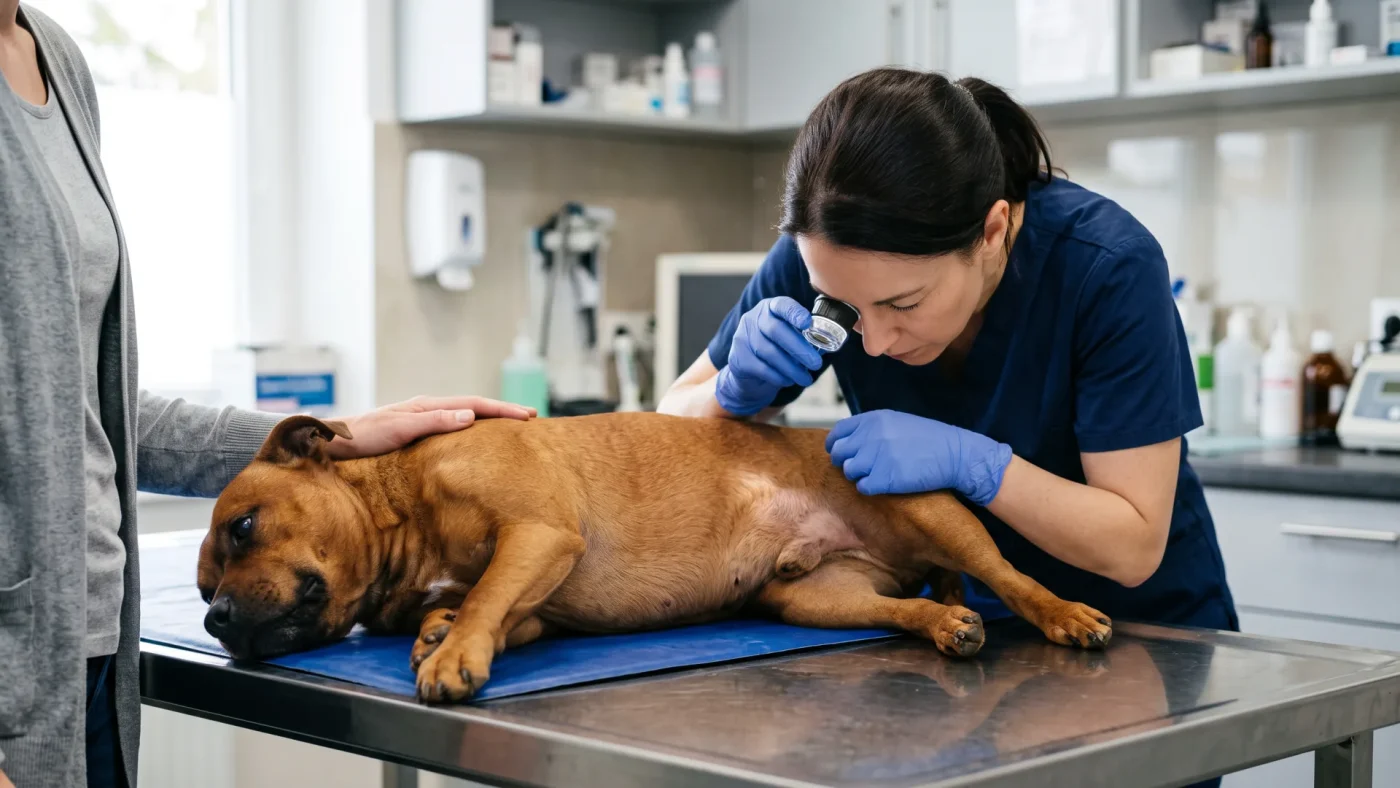
Changing shampoo, applying creams yourself or giving medication before the examination can change the picture and affect the results of tests such as fungal culture. Keeping dated photos of the signs will help your vet. If these signs started shortly after you brought a new puppy home, also read our article on what to do if you have bought a sick puppy.
Frequently Asked Questions
Do English Staffies Shed a Lot?
They are not heavy shedders, but they shed regularly all year round and more during seasonal changes. Because their short, stiff hairs stick in fabric, you will notice them at home even though the amount is modest.
Can an English Staffy Trigger Allergies?
It can in people who are allergic to dogs. The English Staffy is not hypoallergenic; allergens are found less in the hair than in skin flakes and saliva. Talk to an allergy specialist before bringing a dog home.
How Often Should an English Staffy Be Bathed?
There is no fixed schedule. As long as the dog is not dirty or smelly, there is no need for frequent washing. If your vet has recommended a medicated shampoo, follow the frequency they give.
Does Shaving Reduce Shedding?
No. Shaving a coat that is already short does not stop shedding; it only makes the shed hairs shorter and leaves the skin exposed to sun and irritation. If the hair does not grow back for a long time after clipping, this can be a sign of a problem such as hypothyroidism.
Do Blue English Staffies Shed More?
Colour alone does not increase normal shedding. However, CDA can occur in blue dogs; in that case what you are seeing is not shedding but permanent thinning and hair loss that starts on the back.
The English Staffy’s coat is easy to care for, but it is not a coat that does not shed. A weekly brush, occasional baths and a good diet keep shedding manageable in most homes. What you really need to watch is not the amount of shedding but its pattern: if the skin is healthy and the coat is renewing itself, it is normal; if there are bald patches, itching and changes in the skin, it is time to see your vet.

Most Read Articles
English Staff vs AmStaff vs Pit Bull: How to Tell These 3 Breeds Apart
If nobody has yet asked you “Is that a pit bull?” while you were out...
Oct
Nosebleeds in Dogs: 12 Causes and What You Can Do
ebleeds in dogs can cause concern for their owners. In this post, we’ll look at...
Oct
English Staffordshire Puppy Care: A Step-by-Step Guide to the First Months
English Staffordshire puppy care begins the day your English Staffordshire Bull Terrier (Staffordshire Bull Terrier)...
Sep