


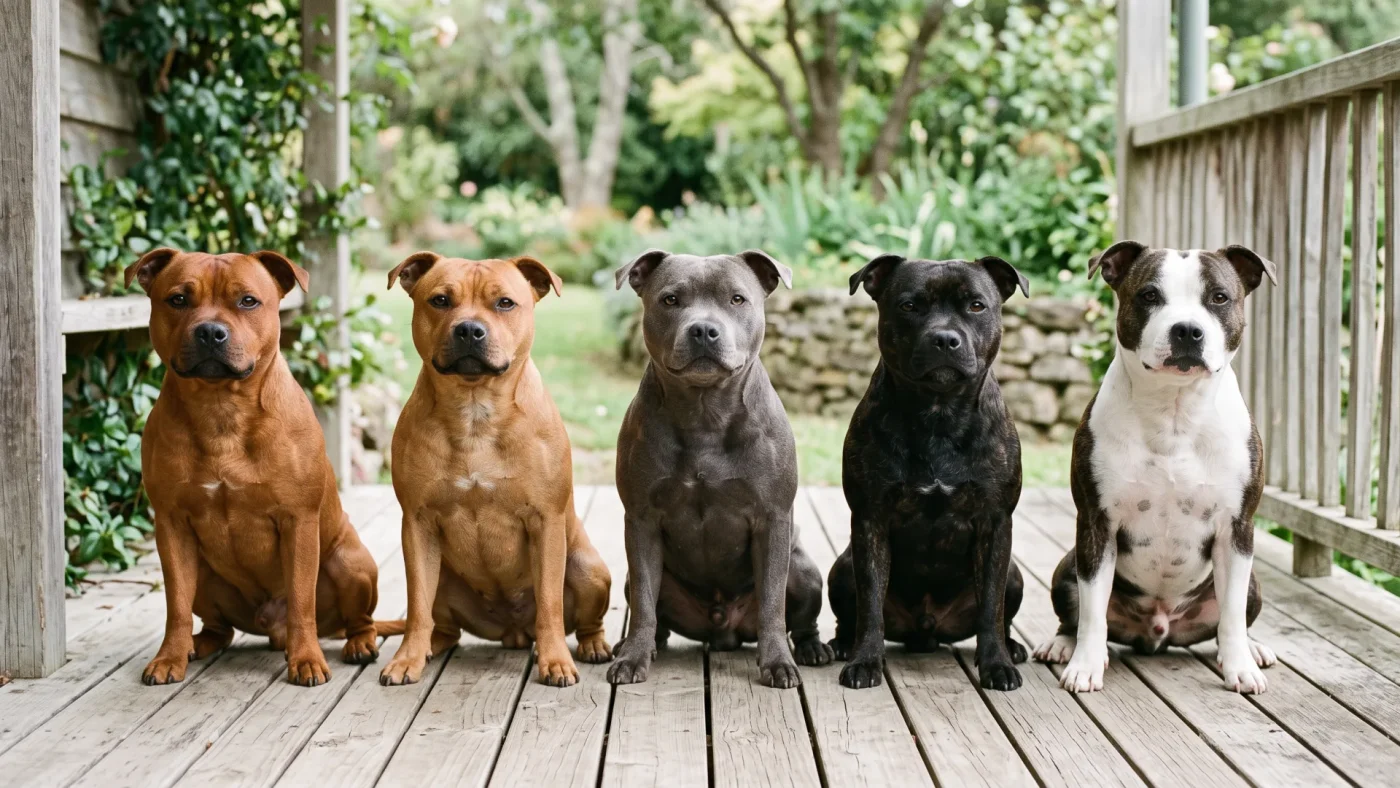
English Staffy colours are one of the features adverts push hardest and the reason most often given for a difference in price. Yet the breed standard for the English Staffordshire Bull Terrier (Staffordshire Bull Terrier) states plainly which colours are accepted. A good share of the colours sold as “rare” fall entirely outside that standard.
We gave a brief overview of the breed’s general traits in our English Staffy guide. In this article we go through the colours one by one, together with their genetics and their link to health. Our aim is for you to know what the colour name in an advert actually means.
English Staffy Colours at a Glance
| Colour | In the Standard? | Notes |
|---|---|---|
| Red | Yes | Shades from light red to deep russet; black nose |
| Fawn | Yes | Yellowish, light brown shades; black nose |
| Black | Yes | Very dark brindle dogs can look black at first glance |
| Blue | Yes | A diluted form of black; the parents’ skin history matters because of CDA |
| White | Yes | Solid white, or coloured patches on a white base |
| Brindle (any shade) | Yes | A dark pattern resembling tiger stripes on a lighter base; the shade varies with the base colour and the density of the stripes |
| Any of the above with white | Yes | White on the chest, feet and face, or a pied pattern in which white dominates |
| Black and tan | No | Unacceptable according to the Kennel Club; a disqualification under the AKC standard |
| Liver or “chocolate” | No | A brown nose gives it away; unacceptable according to the Kennel Club; a disqualification under the AKC standard |
| Lilac (isabella) | No | Liver combined with dilution |
| Merle | No | According to the AKC it does not occur genetically in the breed; the Kennel Club has not registered merle puppies since 2010 |
What Does the Kennel Club Standard Say?
The Kennel Club (known today as the Royal Kennel Club), which sets the breed’s main standard, lists the colours as follows: white; red, fawn, black or blue, or any one of these colours with white; any shade of brindle, or any shade of brindle with white. Every other colour or colour combination, including black and tan and liver, is defined as “unacceptable”.
This wording is new. In the text of the standard used for many years, black and tan and liver were described as “highly undesirable”. The text updated on 1 November 2025 draws a clearer line: a dog with a feature the standard defines as “unacceptable” cannot be awarded at breed shows. The AKC standard in the United States, updated in 2025, also treats black and tan, liver and merle as disqualifications.
The Standard Colours One by One
Red English Staffy
Red English Staffies come in a wide range, from light copper shades to deep russet. The standard calls for a black nose. This detail matters: a “red” dog whose nose, lip edges and eye rims are brown is most likely not red at all but liver, which is outside the standard.
Fawn
Fawn is the name given to shades between light brown and yellowish cream. The line between red and fawn is not sharp; the same dog can look closer to either colour in different light. Fawn dogs also have a black nose.
Black English Staffy
The answer to “Can an English Staff be black?” is clear: black is one of the colours the standard lists explicitly, so it is neither rare nor non-standard. Very dark brindle dogs can look black at first glance; the stripes only show in strong light. This is why the Kennel Club’s registration list includes black, black brindle and dark brindle as separate options.
Blue (Blue Staffy)
Blue, listed in adverts as “blue staff”, is a diluted form of black pigment and a standard colour. The standard asks for the nose to be as dark as possible in blue dogs. Blue is not a rare variety, and the health question that comes with it is covered in detail in our article on colour dilution alopecia (CDA).
White and Combinations with White
Solid white dogs also meet the standard. White can combine with other colours in two ways: a coloured dog can have white areas on the chest, feet or face, or there can be coloured patches on a white base. In the registration list the second case appears as “pied”, for example “white and red pied”.
Brindle Staffy
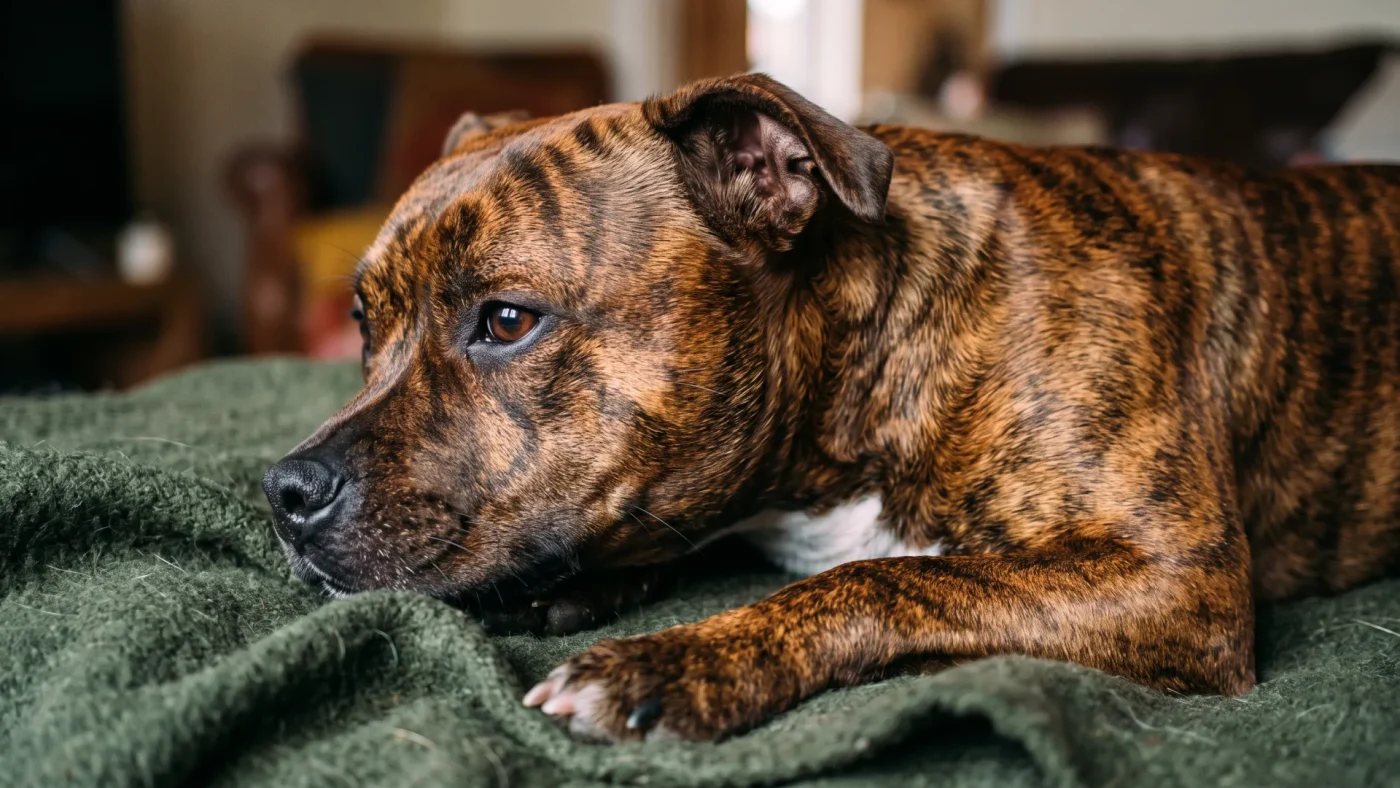
Brindle is a dark pattern resembling tiger stripes on a lighter base colour. Because the standard says “any shade of brindle”, red brindle, fawn brindle, blue brindle and dark (black) brindle dogs with very dense stripes all meet the standard. Brindle Staffy puppies can also have white. The density of the stripes varies a great deal from dog to dog, and that difference is not a sign of quality.
Non-Standard Colours: Black and Tan and Liver
Black and tan is a pattern with reddish-brown markings above the eyes and on the cheeks, chest and legs over a black base. It is common in many breeds but is not accepted in the English Staffy standard.
Liver is often sold as “chocolate” in adverts; the two are the same colour. In this colour brown pigment takes the place of black, so the nose and paw pads are brown too. A puppy offered as a “chocolate English Staff” is a colour the standard defines as unacceptable.
“Rare Colour” Marketing: Merle, Lilac and Chocolate
Some sellers promote colours that are not in the standard as “rare”, “special” or “exotic” and ask a higher price for them. If a colour is not in the breed standard, its rarity is not a mark of value; more often it signals a non-standard mating or a cross with another breed.
Merle
Merle is a pattern that creates irregular light and dark patches on a solid base colour. The AKC’s Staffordshire Bull Terrier standard, updated in 2025, states that merle does not occur genetically in this breed and disqualifies merle dogs. The Kennel Club also does not register merle English Staffy puppies born from matings on or after 5 January 2010, citing the risk of sight and hearing problems linked to the merle gene.
If a pattern that does not exist in the breed shows up in a puppy, it is very likely to have entered the bloodline from outside, from another breed. A merle “English Staff” is therefore a serious question mark in terms of both breed and health.
Lilac and Chocolate
Lilac (in some breeds also called isabella) is a pale, greyish-brown shade that results when liver and the dilution gene come together in the same dog. Because liver is not accepted in the standard, lilac, its diluted form, is not accepted either. Chocolate, as explained above, is simply another name for liver.
If you come across an advert asking a high price because of a colour name, ask whether the colour is in the standard and request the parents’ health test results. When assessing the seller, take a look at our guide to choosing a responsible breeder. If you are not sure whether a puppy with a non-standard colour is really an English Staff, the signs in our article on the differences between the English Staff, AmStaff and pit bull may also help.
Colour Genetics: How Does Blue Come About?
Two genes explain most of the debates about colour in English Staffies. The first decides whether the pigment is black or brown; the second decides whether that pigment shows at full strength or diluted. In both genes the form that produces this effect is recessive, which means the dog has to inherit the same form from both its mother and its father.
- Black pigment and two copies of dilution: A blue dog.
- Two copies of brown: A liver (chocolate) dog with a brown nose.
- Two copies of brown and two copies of dilution: A lilac (isabella) dog.
Because the dilution gene is recessive, if two dogs that are not blue both carry it, some of their puppies can be born blue. All the puppies of two blue dogs, on the other hand, will be a diluted colour. Whether the parents carry the dilution gene can be found out with a DNA test.
Blue and CDA: What You Need to Know
Colour dilution alopecia (CDA) is an inherited coat and skin problem seen in dogs with dilute colours. At birth the puppy’s coat looks normal; the signs appear over the following months, sometimes later: thinning hair in the dilute-coloured areas, permanent hair loss and recurring superficial skin infections. Not every blue dog develops CDA, but the dogs in which CDA is seen are dogs with dilute colours.
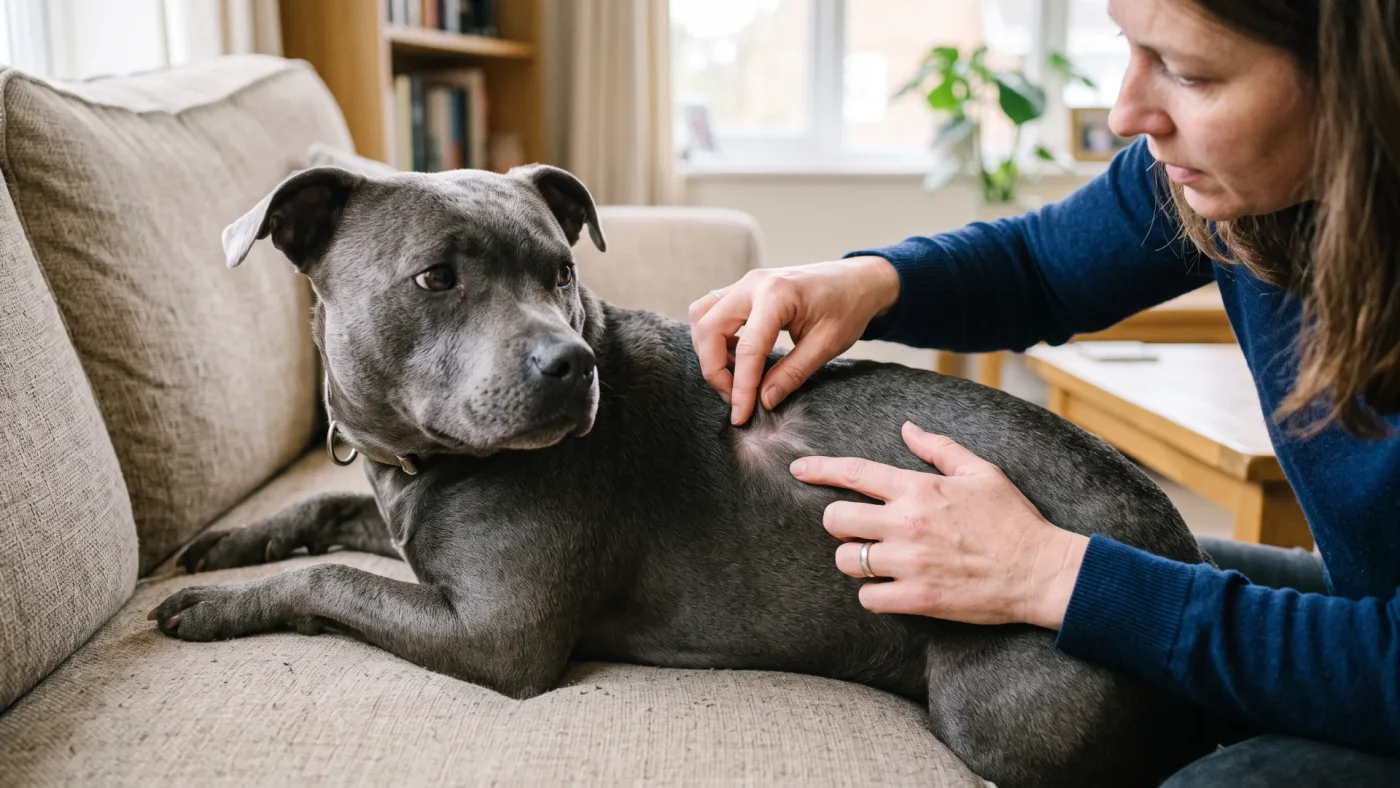
CDA is not regarded as a disease that threatens the dog’s overall health, but there is no definitive cure and skin care often lasts for life. For the details, see the CDA article linked above; for the story of a dog living with this condition, read one owner’s account. If you are considering a blue puppy, always ask about the mother’s and father’s skin and coat history.
Does Colour Determine Character?
No. The English Staffy standard describes temperament independently of colour, and there is no official source that links colour to character. The Kennel Club also stresses this point about colour: colour is only one criterion when choosing a dog; health and temperament should always come before colour.
A dog’s temperament is shaped by its parents’ character and by the attention and socialisation it receives in its first weeks. Colour is only a topic on which you need to ask extra questions for health reasons, especially with dilute colours and non-standard patterns. For the full range of the breed’s health issues, see our article on Staffordshire Bull Terrier health issues.
Does a Puppy’s Colour Change as It Grows?
Puppy coat usually sheds at around 4-6 months of age and is replaced by the adult coat. During this change the shade can darken or lighten somewhat in many breeds, and in English Staffies too the puppy’s shade may not stay exactly the same into adulthood. The genetic type of the colour, however, does not change: a puppy born black does not turn red, and a puppy born red does not turn blue.

That is why looking at the mother’s and father’s colour and coat quality, rather than at the puppy’s current shade, gives you a more accurate idea. This matters even more with blue puppies, because the signs of CDA are not visible at birth.
Frequently Asked Questions
What Is the Rarest English Staffy Colour?
The standard does not classify colours as rare or valuable. The colours sold as “rare” are usually non-standard colours such as merle, lilac or chocolate.
Are Blue Staffies Unhealthy?
No, blue on its own is not a disease, and it is a standard colour. However, because CDA can occur in dogs with dilute colours, you need to ask about the parents’ skin and coat history.
How Can I Tell a Red English Staffy from a Liver One?
Look at the nose. A red English Staffy has a black nose. A dog whose nose and paw pads are brown is liver (chocolate) and outside the standard.
Can an English Staffy Be Merle?
Not according to the standard. The AKC states that merle does not occur genetically in this breed, and the Kennel Club has not registered merle puppies since 2010.
What Does Brindle Staffy Mean?
It means an English Staffy with dark stripes resembling tiger stripes on a lighter base colour. Whatever the shade of the base and the stripes, brindle meets the standard.
In short, the accepted colours of the English Staffy are clearly defined, and none of them is more valuable than another. Choose a puppy not for its colour, but because it has healthy parents, proper paperwork and a seller who answers your questions openly.

Most Read Articles
English Staffy Colours: Standard Colours, ‘Rare Colour’ Marketing and Health
English Staffy colours are one of the features adverts push hardest and the reason most...
Oct
Hypothyroidism in Dogs: Causes, Symptoms, and Treatment Methods
In this blog post, we’ll talk about hypothyroidism, a prevalent health concern in dogs. We...
May
English Staffordshire Bull Terrier Guide: Traits, Temperament, Health and Care
The English Staffordshire Bull Terrier (officially the Staffordshire Bull Terrier, “Staffy” for short, and usually...
Oct